

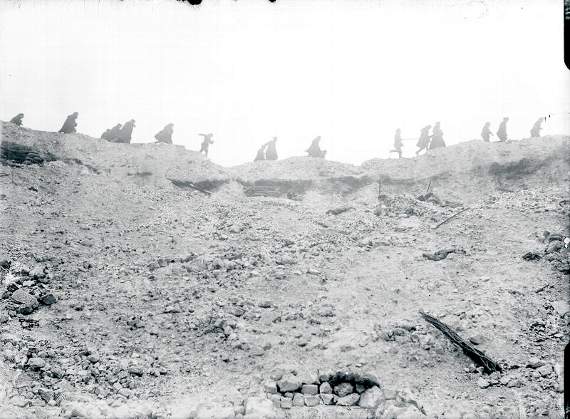
The Battle of the Somme, fought in Northern France, was one of the largest, most infamous battles of the First World War. The fighting lasted five months, beginning on July 1st and ending on November 18th, 1916.
Over the 141 days of the battle, the British and French armies engaged the Germans in a brutal battle, across a 15 mile front. The aims of the battle were to relieve the French Army, who were fighting at Verdun, and to weaken the Germans.
All sides sustained heavy casualties; more than one million men lost their lives, or sustained severe injuries. The Somme is notorious for being one of the bloodiest military battles in history. On the first day alone, there were 57,470 British casualties. On this day, the Allies sent 100,000 men over the trenches.
The day was a disaster for the British. The Germans weathered the artillery fire in deep trenches and came up fighting. As the British soldiers advanced, they were mown down by machine gun and rifle fire.


Today, July 1st, marks the Centenary of the first day of the battle.
Press coverage of first day of the Battle of the Somme
All newspapers were resticted as to what they were allowed to report. If it had been documented in the press that tens of thousands of men had been killed in a single day, this would have obliterated morale at home; mothers, fathers, wives and siblings of soliders would have feared they had lost their loved ones, especially as it could take months for news to reach home to confirm that a soldier had been killed.
Because of these restrictions, there was only a brief reference to the first day of the Somme Offensive in the Ross Gazette, published after the first day of the battle. The information was buried deep in an article about the courage of the French soliders; the majority of the article was focused on how the British owe a debt of gratitide to the French Army and why there was going to be a day in which to celebrate this.
The article was as follows:
“Friday week, July 14th is to be observed throughout the country as ‘France’s Day,’ and a National Demonstration inaugurated by the Lord Mayor of London will be held, to show our cordial feelings towards a friend and Ally, to pay tribute to their brave army and to give substantial proof of our sympathy with their wounded soldiers.
“The heroic part that France has played and is playing in the tremendous struggle between civilisation and “Kultur” has aroused the admiration of the whole world. The defence of Verdun against an attack conducted with unexampled ferocity and persistence over a period of nearly twenty five months, will go down in history as one of the most glorious military episodes of the war.
“The courage and tenacity of the French soliders through these long months of incessant warfare have enabled the plans of the Allies to mature, with the result that the combined offensive, so auspiciously inaugurated on Saturday last, had not to be prematurely entered upon.
“When we remember that a large part of the rich manufacturing districts of France is in the hands of the enemy, and that the rest of the country has to support large numbers of their own refugees, as well as many poor Belgians, it will be seen that we owe to France an unmeasurable debt of gratitude.”
The passing reference to an encounter “Saturday last”?at the end of the third paragraph of the article refers to the First Day of the Battle of the Somme on July 1st. It is sobering to think that reporters would have been as resticted as they were, especially when it came to reporting such an important, world-changing event.
It was not just the Ross Gazette that could not report the true nature of the Battle. The event went largely unreported in the larger, national newspapers, and if it was covered in the press, the disasterous first day was described as a victory.To read the full feature about the Battle of the Somme, including stories about soldiers from the Ross-on-Wye area who fought and died in the campaign, pick up an edition of this week's Ross Gazette.
Comments
This article has no comments yet. Be the first to leave a comment.