

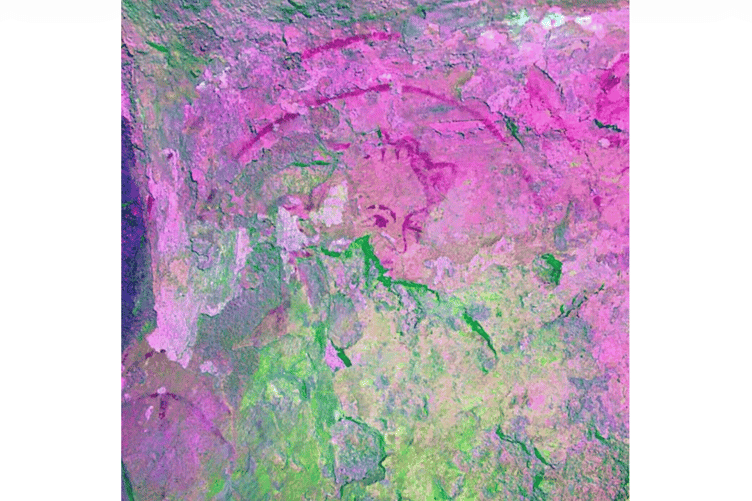
PART of a rare medieval wall painting has been discovered by English Heritage conservators doing routine work on the chapel at Goodrich Castle.
They uncovered a delicately painted male face with wavy hair, which would have once been part of a much larger painting covering the chapel walls.
Dating back more than 700 years to the mid 1200s to early 1300s, the painting was found on a small piece of plaster in the chapel’s south wall window embrasure.
English Heritage wall paintings conservator Sophie Stewart said: “This is a thrilling discovery and one with huge implications for how we understand the chapel at Goodrich.




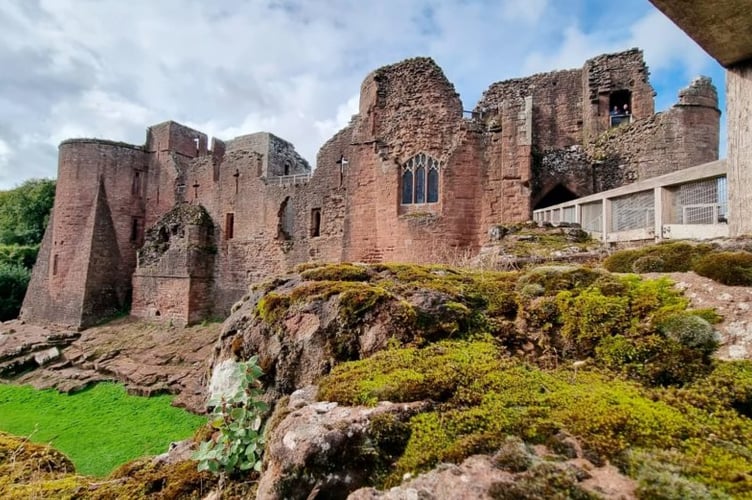
"We knew that traces of medieval wall painting survived here, but to see this tiny painted head emerge from the plaster was incredibly exciting.
"It shows that the chapel was once decorated with a far more elaborate scheme than we had realised.
"Even more astonishing was the discovery of a microscopic particle of the blue pigment azurite.
"It may be tiny, but the presence of this very expensive material tells us that the painting would also have been colourful and of very high quality.”
She told The Church Times: "Although wall paintings were relatively common in religious buildings, to find figurative subjects in a secular setting is rare.
"It showed that there was a figurative narrative scheme, which meant the chapel had so much more important decoration.
“The typical format was a series of separately framed scenes to tell a complex biblical, moral, or historical story.
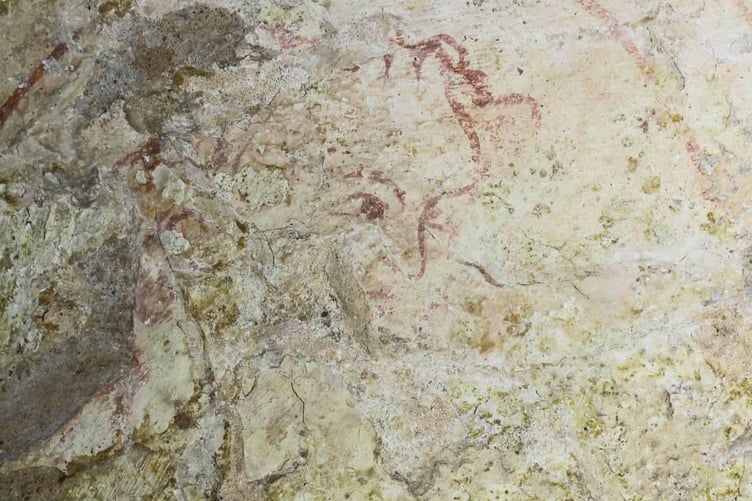
"This little figure is in a frame; so it’s clearly a very sophisticated sort of painting. He’s very beautifully executed as well, and clearly of very high quality.
“We know that, as a private chapel, it would have served as an intimate sanctuary – a personal space where high-ranking nobility could engage in personal worship. The two-window recesses have ledges that could potentially have been places to sit.”
They also found traces of a second figure, with a halo.
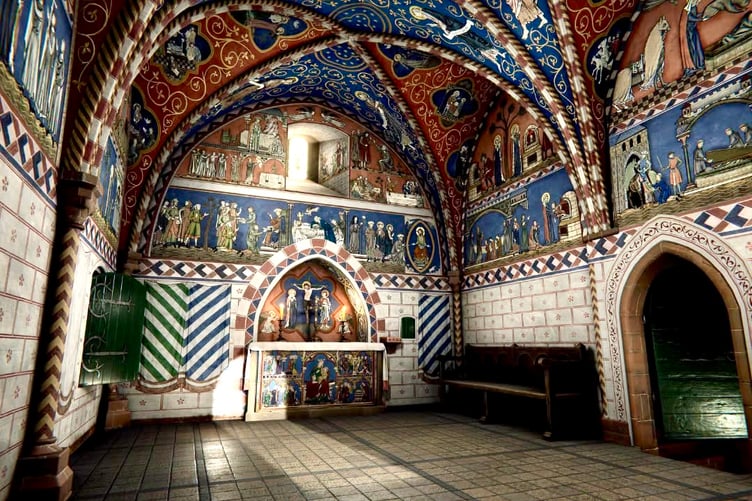
Experts have now used rare surviving fragments found at Chester Castle to digitally reconstruct how the chapel at Goodrich may have looked 800 years ago, rich with colour and imagery.
The first castle was built in around 1100 by Godric Mappeson, who gave Goodrich his name, and was then rebuilt in the mid 1100s by famous Norman knight Richard ‘Strongbow’ de Clare.
It later belonged to King John who gifted it to the 'greatest knight' William Marshall in the early 1200s, before passing to John’s son Henry III by the middle of the century.
William de Valance, uncle to Edward I, who accompanied him on a crusade to the Holy Land and fought with him in Wales, also owned it later.
Hundreds of years on, in 1643, the castle was caught up in the struggle for control of Herefordshire and the Welsh Marches during the English Civil War, becoming a major Royalist garrison.
But after a ferocious siege, the Parliamentarians finally retook the castle on July 31, 1646, after bombarding it with the Roaring Meg mortar, which takes pride of place today in the courtyard.
With the surrender of the Royalists, the victors then slighted the battlements and towers, rendering it indefensible.
Comments
This article has no comments yet. Be the first to leave a comment.