

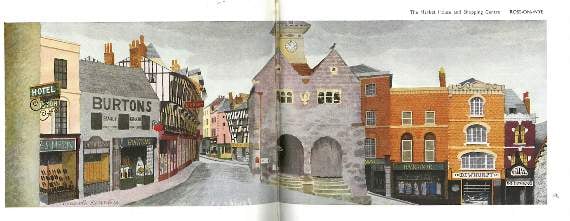
A picture of Ross-on-Wye as a thriving market town is quickly gleaned from a cursory glance through a wonderful book which the Ross Gazette was loaned recently. Mr Michael Winch, former auctioneer, owns the book called English County - a Planning Survey of Herefordshire, which was published in 1946.
The book, according to the foreword, attempts to put into perspective “the elements of climate, geography and soil, of town and village, of industries and communications, which make up the fabric of Herefordshire.”
The Survey acknowledges the importance of its history of farming and also the growth of the manufacturing industry. Referring to the end of World War II, the book acknowledges that “peace heralds further changes, different opportunities and, it may be, some dangers.”
In order to achieve a good future for the county, the authors believed that the three year’s research which went into the book will help “all who hold the county in affection’ to grasp the general view of Herefordshire and its many-sided life.”

The books looks at the land, the people, industry and agriculture, the social environment and public services. The survey was carried out by volunteers, many of them professional and well-qualified, to provide a ‘groundwork of facts upon which those responsible for planning could base their schemes.’
The survey found that most Herefordshire industries were quite small due to the limited accessible labour supply. In the drinks industry one of only three factories employing more than 50 people was a brewery in Ross. Across the county there were four food production factories employing over 50 workers but the remaining food plants included nearly 100 bakers and confectioners, employing one or two people.
War had helped to increase the number employed in central and local government, and in certain industries which had evacuated to Herefordshire.
These included a small plant refining lubricants in Ross. The company selected this location partly because it is near the centre of the region to be supplied with the product. There was also a factory for precision tools for engineering in Ross.
Changes in the way people lived and worked within a small area was already changing. At the time of the survey villages, and even what are referred to as ‘tiny settlements’, possessed a church or chapel, a school, general store, a post office and an inn, while some had a village hall. Then, as well as the services provided in the market towns, such as Ross, there were 18 doctors with consulting rooms in 15 villages, and bank branches in five villages. A large village was one with 250-500 inhabitants, about 60 houses.
The survey states: “Generally speaking, however, the diminutive size of the county’s rural settlements effectively precludes them from offering the extra amenities and the wide range of services the country dweller is coming more and more to demand and which will keep the rural population from migration.”
It also says that country people are increasing turning to the market towns for a wide range of shopping facilties, professional services, higher education and recreation.
The survey comments that Ross had two cinemas which was explained by the town’s importance as a holiday and recreational centre, and this also accounted for the large number of cafés in the town.
In addition to diagrams showing how many public telephones were available in the county (pictured below left), to the number of buses including extra ones on market days, the survey looked at the library service. The book states: “Public Libraries have a recreational role of real importance in the social life of the community.” In 1943-4 one in every three citizens of Hereford used the Library.
In Ross the public library was situated in a shop.
See the full story in this week’s edition of the Ross Gazette, or subscribe to our online edition here
Comments
This article has no comments yet. Be the first to leave a comment.