

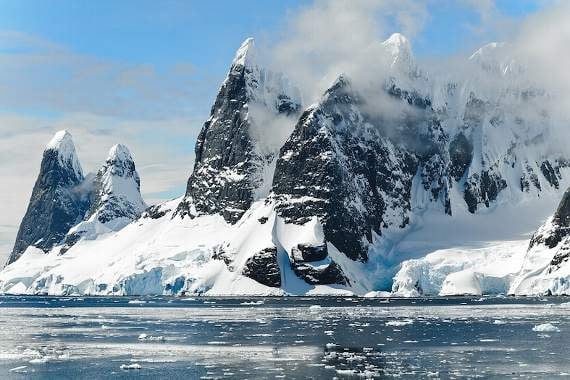
David Fletcher has spent most of his working life in Antarctica after going out there in the 1960s as a biologist and sled-dog driver. He began his talk by paying tribute to the seamen and aircraft pilots who take considerable risks to supply and transport scientists in this unforgiving wilderness. He said that scientists often forget just how much their lives depend on such courageous and skilful people.
David gave a brief history of transportation in Antarctica, from the pioneering days of Scott, Shackleton and Amundsen sailing there in converted whaling ships, to the ‘Blue Ice’ runways for Hercules Transport planes of today. Then, Antarctica was an unknown continent, so early explorers were discovering a new world.
Scott used air balloons in 1902 to survey the terrain, Shackleton used a converted motor car in 1907. It was not until 1935 that the American, Lincoln Ellsworth flew across Antarctica.
David explained that today’s worker is a researcher rather than an explorer, sending back data to a base often up to 500 miles away. Aircraft are used regularly to carry scientists and equipment to their stations.




Moving equipment suggests a dog-team careering across frozen wastes, but in fact the last team left in 1966. Feeding the dogs seal meat involved catching the seals first. Research teams in such an environment found dogs too slow. The trip from base to outlying station might take weeks, followed by two months’ research and then weeks to return to base.
Eventually, various countries developed vehicles suited to the purpose, though previously improvised transport had been a common sight. Particularly successful were the Russians who used former tracked missile carriers. Today the Americans use Snow-cats as do the British. Eventually Bombardier, the Canadian Engineers, built a totally metal engine which could be heated by blowlamps. In this country we might spend five minutes warming the family saloon, in the Antarctic at minus 60, it takes two hours.
Air transport has become fundamental to life in Antarctica. Properly engineered ‘Blue Ice’ runways allow Hercules Transport planes to land, bringing tons of supplies, scientists and a growing number of tourists. Smaller aircraft, fitted with skis, fetch and carry.
The pilots are immensely courageous and skilful. They land on virgin snow with no way of knowing what lies beneath and no means of braking, but David said that, without them, scientists would die. Fuel for aircraft and motorised vehicles is the same high-octane petrol, so regular deliveries of 5,000 drums each, which weigh about 400 lbs and take five days to unload and stow.
David is the authentic voice of a profoundly unique way of life devoted to science and he is an ever-popular speaker. He ended by underlining the good relationship between the scientists of the 28 countries now at work in Antarctica and repeating his tribute to the pilots and the ships’ crews when he said that without them, there would be no science taking place on that desolate Continent.
Ross Science Society meets at the Castle Lodge Hotel. The next meeting is on Wednesday, January 10th, at 7pm for 7.30pm start. The topic will be local geology, mainly Worcestershire, by Peter King, who will be taking a view of local stone, engineering works and landslips.
Comments
This article has no comments yet. Be the first to leave a comment.