
The art and the science of Britain’s big cats is the subject of a five week exhibition underway at the Dean Heritage Centre, finishing on 4 May.
During the first week curious visitors have journeyed from as far as Yorkshire, South Wales and north Worcestershire to learn more about the topic and study the artwork.
Curator of the event Rick Minter hosts the Big Cat Conversations podcast, and networks with investigators of big cats in the region, some of whom are coming to meet the event’s visitors. A special episode of the podcast is being recorded on the final weekend of the event, with several big cat witnesses coming together to discuss their encounters.



Rick said “the event has got people talking about the big cats described in the area, and we’ve made new contacts who are keen to support the subject by using trail cameras and following up reports. Ironically on the first day of the event we had two different visitors from Cornwall describing their chance sightings of a black panther – that was a turn up when we were expecting to hear more reports from the Forest.
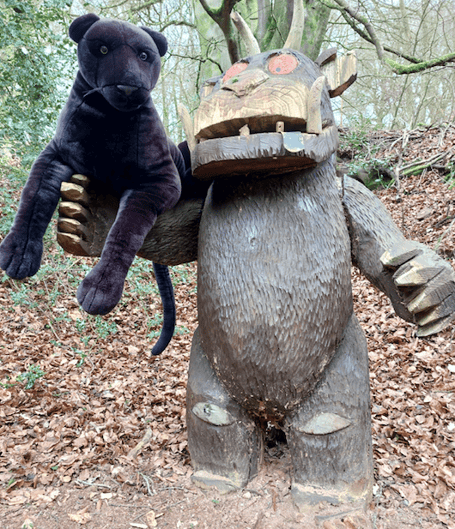
“We did get several descriptions of black panthers seen in the Dean, on the opening night talk with local people. We’ve also had a few laughs, putting our large toy panther mascot in the hands of the giant Gruffalo on the Centre’s Gruffalo trail – it proved a popular photo opportunity for families!”
“The artwork depicts the three types of large cats described by witnesses – the black leopards or panthers, the tan coloured pumas, and the lynx. They are all shown in British habitats and landscapes, making the point that they have adapted their secret lives to the environment here, including the Dean. They will be mainly focused on deer as their prey, and some of the best evidence comes from the freshly devoured prey carcasses when people stumble upon these.”
As well as the art in Gallery 41, activities are scheduled at weekends. On 18-19 April, researcher Leo Willis from the Royal Agricultural University will be visiting to explain evidence from tooth marks on bones of suspected prey.
Reports of big cat sightings in the UK have circulated for more than half a century, forming one of Britain’s most enduring modern wildlife mysteries. Accounts rose sharply in the late 1960s and 1970s, often linked to the keeping of exotic animals as pets before the Dangerous Wild Animals Act was introduced in 1976. From that point, stories emerged suggesting some owners may have released large cats such as pumas or leopards into the countryside.
High‑profile cases followed, including the Beast of Bodmin Moor in Cornwall, the Exmoor Beast in Devon, and numerous “black panther” sightings across Wales, the Forest of Dean and the Home Counties. Witnesses have described large, powerful cats, unexplained livestock kills and tracks, though definitive physical evidence has remained elusive. Despite scepticism from authorities, the consistency of sightings over decades, often from experienced observers, has ensured that Britain’s big cats continue to intrigue researchers, media and the public alike.
Comments
This article has no comments yet. Be the first to leave a comment.