

The exhibition at Monmouth Museum to commemorate the centenary of the birth in 1918 of the artist Otto Maciag and the display of work by the pupils and people he inspired, comes to an end on June 30th.



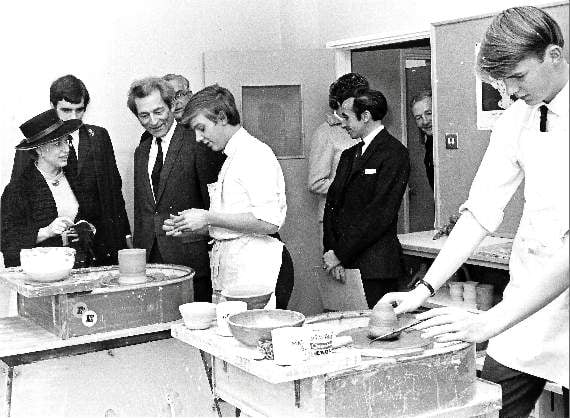
Otto spent the majority of his life in Monmouth, taking up the post of Head of Art at Monmouth School in 1947, where he remained until his retirement in 1978. In that role he touched many lives and influenced their course, providing them with a solid foundation in drawing, painting and ceramics as well as teaching history of art and architecture. Looking around the exhibition on the mezzanine at Monmouth Museum demonstrates the impact that he had on those who were able to carve out successful careers of their own.
Otto retired at 60 so that he could dedicate more time to his own work, in particular to his painting, and the exhibition features just some of his tremendous output in oils. He painted many Welsh landscapes and working in the Wye Valley had many opportunities to display his mastery and love of capturing reflections in water, and the effects of light.
Otto came to Britain during WW2. Of Polish and Dalmatian descent, born in Hungary, he grew up and was educated in Poland. He shared his love of art and talent, as well as love of horses and nature, with his two brothers. But War tore the family apart. He fought for the defence of Poland in September 1939 but trapped between Russian and German invaders he crossed into Romania and was interned. With forged papers he escaped reaching Lebanon and finally Marseilles where he joined the Polish Armed Forces in the West. After the fall of France he managed to reach Britain and was stationed with an anti-aircraft artillery unit in Scotland and was able to join wood engraving, linocut and life-drawing classes there. In 1944, fighting as an officer in the First Polish Armoured Division, he took part in the Normandy landings, and fought in France, Belgium and Holland. After the war he was able to study at Liverpool College of Art, a rare achievement for a Polish exile.
The exhibition provides an opportunity to see a range of his work as well as family photographs and story that make the exhibition so special.
Comments
This article has no comments yet. Be the first to leave a comment.