

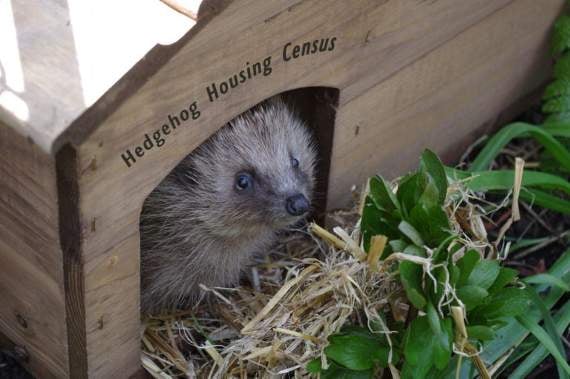
School’s out for the summer, and for those now at home what better way to spend a sunny afternoon than by creating your own hedgehog house, to help the nation’s favourite mammal from further decline, especially during the current heatwave.
The Hedgehog Street team - run by wildlife charities the British Hedgehog Preservation Society (BHPS) and People’s Trust for Endangered Species (PTES) - is urging people to help hedgehogs by building them the perfect home, providing a safe haven that’s cool, cosy and comfortable during this unusual summer weather.
Last year, Hedgehog Street launched the first ever Hedgehog Housing Census, which looked at how, when and why hedgehogs use either homemade or artificial hedgehog houses in gardens across Britain.
Between August and October 2017, over 5,000 people responded to the Hedgehog Housing Census, and now, a year on, the secrets behind what makes a perfect hedgehog home have been revealed. The results, analysed by the University of Reading, show that:



• Hedgehogs prefer homemade houses, but artificial houses are still a good alternative if they have the right features.
• Hedgehogs need time to get used to a new house before they use it.
• Feeding hedgehogs, putting water in your garden and providing bedding (such as dry leaves, pet straw or both) increases the chances of a resident hedgehog moving in.
• Hedgehogs prefer houses found in back gardens, in shaded areas.
• Pets or badgers don’t appear to put off a ‘hog’ from moving in.
Building your own hedgehog home is a fun and easy to do. To download a PDF with simple instructions on how to build two different types of hedgehog house, visit: www.hedgehogstreet.org/
housingcensus
Interestingly, the results also showed that houses positioned close (five metres) to the homeowners’ house are most frequently used, indicating that hedgehogs have become accustomed to human activity.
Also, of those who responded to the questions about usage for daytime resting and hibernation, 81% found evidence that their hedgehog house was used for resting during summer daytime, 59% noted that it was used for hibernation during winter months and 28% said it was used for breeding.
Abigail Gazzard, Postgraduate Researcher for the University of Reading adds: “Further analysis is required to investigate why hedgehogs seem to prefer homemade houses to artificial ones. This could be to do with the type of materials they are made from, its physical size, or whether it has other features such as tunnels and internal partitions, so the next step for us is to look into this aspect specifically.”
Comments
We've recently changed our login process. If you have an account for commenting, you will need to re-register on the login window.
This article has no comments yet. Be the first to leave a comment.