

The first Field of Remembrance was held in the grounds of Westminster Abbey in November 1928, ten years after the end of World War I. That year only two Remembrance Tribute Crosses were planted. But it began a tradition that took root and has grown and grown over the decades. Each Remembrance Tribute carries a personal message to someone who lost his or her life in the Service of our country.
Last year, for example, the widow of a soldier who died while serving in Afghanistan planted a cross at Westminster. She said that it helped “…bring home how many people have lost their lives and how important it is that we never forget what they have done for this country.”
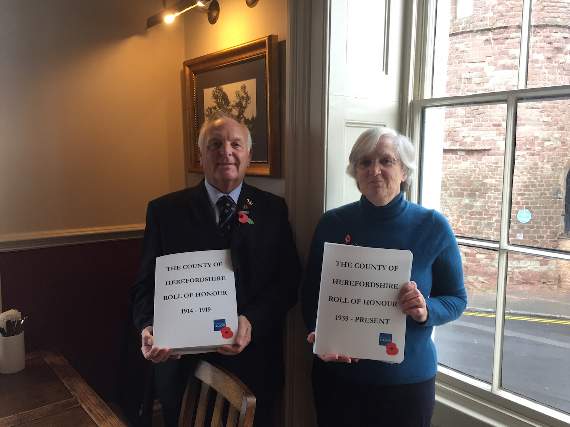
For the 90th anniversary of the Poppy Appeal in 2011, other Fields of Remembrance were established at Belfast, Cardiff and Edinburgh. Now, inspired by the Acts of Remembrance during the centenary commemorations of the First World War, and in response to popular demand, the Royal British Legion Herefordshire, in conjunction with the Cathedral authorities and Hereford City Council, are to establish a Field of Remembrance in Hereford as a county-wide focus for Remembrance.
The Herefordshire Field of Remembrance will be in the Lady Arbour alongside the Cathedral. Following the same timings as for the National Field of Remembrance at Westminster Abbey, the local Field of Remembrance will be dedicated at a short ceremony on November 5th and will be open to visitors for 10 days from 10am until 3pm, closing on Sunday, November 15th.



Approximately 4,200 Herefordshire-based personnel of the Royal Navy, Army, Royal Air Force and Merchant Navy were killed in action between the outbreak of the First World War and today. The memorial garden will be marked out with a representative 420 crosses, each cross representing 10 men or women and the assembled mass of remembrance crosses will be evocative of a military cemetery.
Members of the public will be able to buy a wooden token of remembrance. These were originally all crosses, but now a variety of shapes, suitable for different religions, are available, including one signifying ‘no faith’, each is decorated with a remembrance poppy. The token is generally marked with the name of a member of the armed forces who was killed in action and can be planted in the plot set aside for them.
After the Field of Remembrance closes, the personal crosses will be recovered by members of the Royal British Legion, burnt, and the ashes scattered, ideally at the First World War battle fields in northern France and Belgium.
Comments
This article has no comments yet. Be the first to leave a comment.