
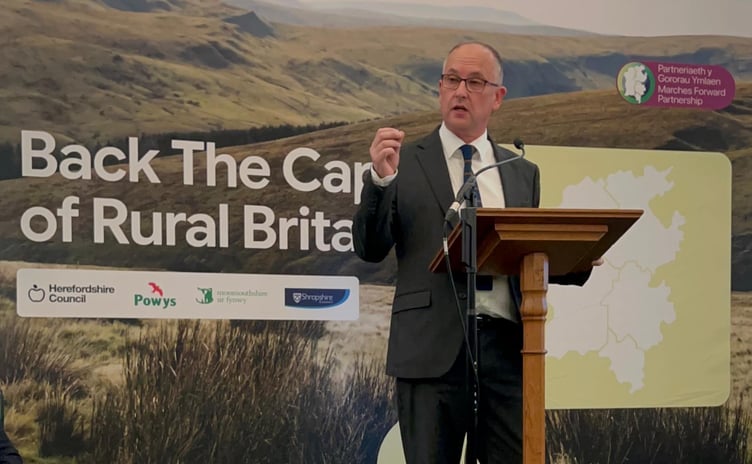
THE Leader of Herefordshire Council joined counterparts from Shropshire, Powys and Monmouthshire at the House of Commons last week which brought together more than 100 representatives from government, business, infrastructure and the farming sector.
The reception provided an opportunity to promote Herefordshire's ambitions directly to decision-makers and build relationships that can help unlock investment and support economic growth in the county.
The four councils also set out the wider potential of the Marches as the Capital of Rural Britain: a connected cross-border economy with nationally important strengths in food, farming, water, energy and environmental innovation.
Councils, businesses, universities, agencies and infrastructure partners are working across borders to develop investment-ready projects and address shared challenges.
The partnership is seeking recognition as a national pathfinder for rural growth and resilience, with government support to help develop projects and unlock investment.
Speaking at the event, Herefordshire Council’s Leader, Cllr Jonathan Lester said: “What we are demonstrating here is that the Marches Forward Partnership is a different model.
“It is not a new tier of government; it is not another layer of bureaucracy; but a practical coalition of places choosing to work together because it delivers better outcomes. It will have the opportunity to develop faster investment decisions.
“In an era where government is rightly looking for productivity, improvements in productivity, value for money, scalable solutions, cross-border partnerships such as ours offer a powerful answer.
“Together, we are showing that together by showing local leadership, businesses, academia and national partners can all be aligned with one single vision.”
“But perhaps the most important lesson from the Marches Forward Partnership is this: the challenges facing the UK do not respect administrative boundaries. Rivers cross borders. Supply chains cross borders. Labour markets cross borders. Environmental risks cross borders.



“Yet too often, our public institutions remain confined by them. Paradoxically, our borders serve to bind us, not divide us.”
Comments
We've recently changed our login process. If you have an account for commenting, you will need to re-register on the login window.
This article has no comments yet. Be the first to leave a comment.