

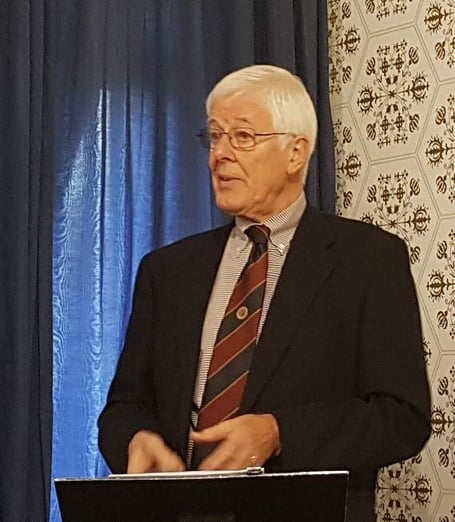
Kyrle Probus member Ashley Letts recently gave a fascinating lecture on China, focused on the first emperor and the Terracotta Army.


In 247BC, YingZheng became ruler of the Qin kingdom at the age of 13, when his father died. Until he reached the age of 22, his mother and first minister administered the state of Qin. From 230BC to 221BC he fought many battles until he achieved control all of the neighbouring kingdoms and declared himself Emperor of the Unified Empire of Qin, basically the China we know today. YingZheng centralised politics, economy, military affairs and culture and was ruthless in removing any opposition.
To improve communications and security, he instigated an imperial road network on a massive scale, enabling him to visit all corners of his empire. One of his greatest achievements was the connecting up, rebuilding and extending defensive walls previously built by individual states, making up the Great Wall of China. When completed in 1600’s, it was 5,500 miles long.
To achieve these goals, he employed more than 2 million people, about 10% of the total population, which stripped the countryside population. Some 700,000 people were involved in building a tomb for the emperor.
In a pursuit of eternal life, he started to take small amounts of mercury as a medication because it was thought to be indestructible and everlasting. In 210BC the first emperor died, probably of mercury poisoning. His body was returned to the capital Xian, being buried in a part completed tomb.
The second part of Ashley’s lecture moved on nearly 2200 years, to 1974 when a farmer digging a well on his land discovered a mass of pottery. Dating the pottery, and searching ancient texts and documents indicated that this area was the tomb of the first emperor of china. This led to a massive archaeological dig revealing the Terracotta Army of an estimated 8000 soldiers each between 5ft 9in and 6ft 7in in size, with 130 chariots plus 520 horses, and 180 cavalry horses. The total tomb complex is estimated to cover 98 sq. km. Until the excavation is completed we will not know whether ancient documents were accurate in their details of this World Heritage site.
Comments
This article has no comments yet. Be the first to leave a comment.