
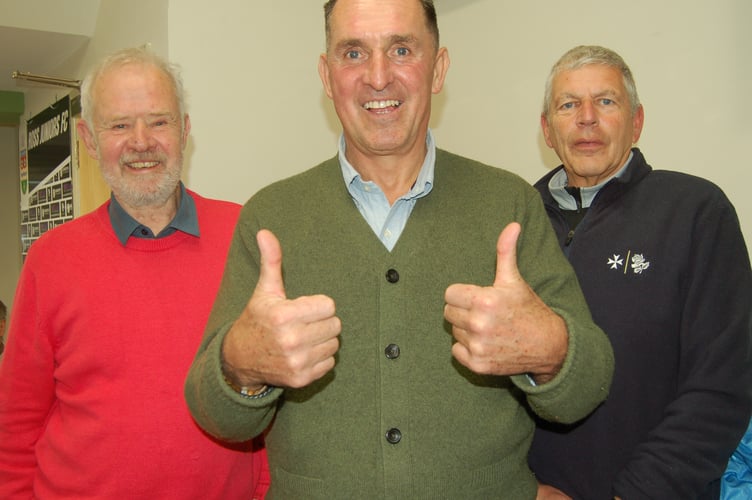
MARTIN Allen explained to the enthusiastic crowd that he had been born into a family with a footballing dynasty; uncle Les, cousins Clive, Bradley and Paul and his father Dennis, before making the quip: “And then there was me…a footballer who went on to collect 53 disciplinary points.”
At the age of eight Martin was playing in the school’s under 11 team and at the age of 14, he was spotted by a scout from QPR and was asked to attend training sessions at the ground.
Martin recalled: “When I was 15, I purchased a copy of the magazine ‘Shoot’ which featured a portrait of Bryan Robson, He was the England caption, one of Manchester United's greatest and I placed it on my bedroom wall.
“My father told me that I should play like him. ‘He is your goal’ he told me.” The poster was to stay on the wall until he moved out many years later.

“Four years later, whilst at QPR and at the age of 19, I was picked to play against Manchester United, and I was to come face to face with my hero,” Martin said.
“My job was to mark him, tackle him, hurt him in such a way to stop him scoring goals. As the game kicked off, I told myself, ‘I am going to get you’.
“We lost 1-0, but I was satisfied my hero didn’t score. When I got home, I went into my bedroom and saw the poster of Bryan starring back at me. I took a moment to reflect back on the day.”
Martin’s other idol was Robin Friday, dubbed the ‘greatest footballer you never saw’ who played for Reading during the mid-1970s and should have played for England.
“I emulated him in more ways than one,” he said. “I wore long sleeved shirts and never tucked it into my oversized shorts. My socks were always down at my ankles.
“Robin Friday had the craziest attitude. He was my hero. I idolised him as an eight- to ten-year-old when I saw him play. And when I became a footballer, I decided I was going to be like him.”
As a teenager Martin shot up in height, but his sudden development meant he lost all his power and strength and consequently was only given a year’s contract at QPR, whilst other apprentices had much longer deals.
“I fought against this decision by creating a brutal training regime during the summer break by attending sessions at my hometown’s boxing club and athletic club, as well as using a multi-storey carpark on a Sunday morning to run up and down the steps.
“I also spent five weeks labouring at a building site and by the end, I could carry a hod of bricks.”
Martin’s mother wanted him to become a journalist and while he was an apprentice at QPR he worked at the local newspaper on Wednesdays as part of his work experience outside football.
And because of the style of writing he had developed at the newspaper; it was noticed later in his career that his programme notes were of high standard and this enabled him to write a weekly column for the Daily Mail.
Sadly, his mother died before she could see him excel in the career that she had wanted for him
Martin then revealed the time he gained notoriety in the national press and explained that Trevor Francis, QPR’s manager, told him he was playing away at Newcastle in the team’s next match, but he pointed out his wife was pregnant, and that he wanted to be at the birth of his child, which was due on the same day as the match.
“The manager told me If I did that, it would be the worst thing I could ever do,” Martin said.
In an era without mobile phones, he remained in contact with his wife throughout by using payphones. But during the early hours of match day, Martin received a call at the hotel from his father saying that his wife had gone into labour.
He arranged to catch a flight from Newcastle to Heathrow that morning and travelled to the Royal Berkshire Hospital and arrived in time for the birth, with the world’s press waiting outside.
Unbeknown to Martin, his father had sold the rights to various media outlets for a family picture and the story.
QPR went on to beat Newcastle 1-0, but when Martin appeared at the training ground, he was fined two weeks wages (around £1,500) but he didn’t mind because the family had made £24,000 for selling the story.
Martin then recounted how he had acquired his nick name of ‘Mad Dog’ whilst playing for West Ham.
He explained that the Sun newspaper had published a front-page picture of an American rabid dog frothing at the mouth. He added that he had recently shaved his head in sympathy with his son, who was suffering from alopecia.
And as Martin was prone to frothing at the mouth and resembled the newspaper’s photograph, the crowd picked up on this and started howling.
Martin then talked about his colourful management carer, which started as an assistant at Reading under Alan Pardew, followed by 13 other clubs, mostly fire-fighting relegation, which included five periods with Barnet.
He said that it was while at Leicester that he found the strength to stand up to the club’s chairman Milan Mandarić,
“It was when I was told striker Jimmy Floyd Hasselbaink had agreed a contract with the club, I pointed out that we already had four centre forwards and we didn’t need another one.
“I considered the values and principles installed in me by my parents and recalled that I should be the best that I can.
“I decided to tell the chairman that he could stick his job. I was sacked. It was one of the proudest, and best decisions I’ve ever made.
Martin is now working for the Football Association as part of its disciplinary panel, despite having one of the game’s worst discipline records.
Martin revealed that Gareth Nutt, who currently is one of the team behind Ross Juniors Pan Disability Group had been his PE teacher at his school from the age 13.
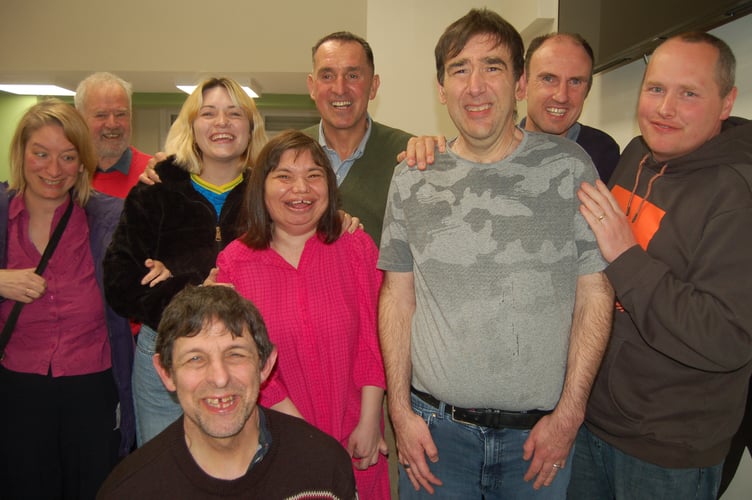
Martin concluded by praising the work of Ross Junior club’s outreach programme and said he was in tears after he had taken some training sessions with the group that had disabilities and learning difficulties and he was impressed with their dedication and commitment to the session.
Comments
We've recently changed our login process. If you have an account for commenting, you will need to re-register on the login window.
This article has no comments yet. Be the first to leave a comment.