
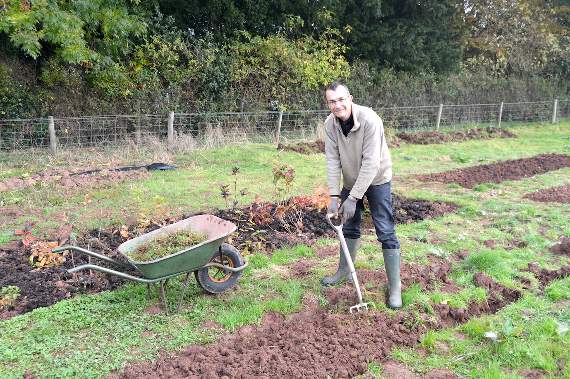
A new social enterprise project, aimed at giving ex-offenders and homeless people horticultural skills, while also producing locally cut flowers, will soon be launched in Lea.
The project, Phocas, was the brainchild of Simon Tarlton (pictured right) who is also a part-time curate at St Mary’s Church, and his partner, Caroline Griffiths. Simon told the Gazette that 15 years ago, he was homeless, but he discovered horticulture and he became a gardener.
Simon said that he and Caroline wanted to do something in the Ross area to give those often left behind by society, such as ex-offenders and those affected by homelessness, a second chance.
The British cut flower industry is another of Simon’s passions. He explained that for a long time, many big businesses seemed to rely on their flowers being imported from other countries, all over the world.


He said that in the past few years, consumers have a larger preference for British cut flowers, especially as more people are becoming conscious about purchasing locally sourced food, to support the local economy and the environment.
Phocas, he explained, was the perfect combination of these ideas, and the project was born.
Currently, the Herefordshire Voluntary Organisations Support Service (HVOSS) are running a programme with the West Mercia Probation Service, to give ex-offenders a step back into the community.
HVOSS speak to ex-offenders to determine their interests, and act as a broker, between numerous community projects, Phocas being one of these.
Once an ex-offender is matched with Phocas, they volunteer at the Lea allotments to grow flowers for up to twelve months, two or three times each week.
During their time with Phocas, the volunteers are taught horticulture and gardening skills, as well as marketing, selling and basic floristry.
At the end of their time with the project, if they want to go into the gardening trade, Simon explained that they have a number of contacts to help them get into the trade. “We hope to mentor them into full-time work, or to even start their own small business,” he told the Ross Gazette. “It’s a part of their rehabilitation back into society.”
He added that they are hoping to work with a local college, so at the end of the volunteers’ time with the project, they can walk away with a formal horticultural qualification.
Simon told the Gazette that the flowers grown and cut at the allotments would be sold at local markets and farmers markets, but they have also already taken bookings to supply flowers for weddings.
The project has been set up as a social enterprise, but Simon explained that through Phocas, it will try to get volunteers into a business mindset; any money made will be channelled back into the project. Within three years, Simon hopes that Phocas will be entirely self-sufficient.
Phocas will be launched formally on November 18th, and the first group of volunteers are anticipated to start working at the allotments within a couple of weeks.
Comments
This article has no comments yet. Be the first to leave a comment.