

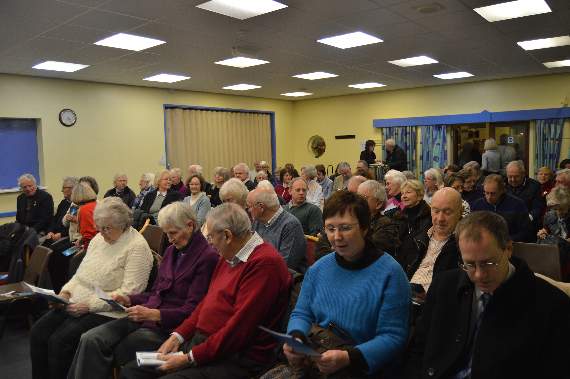
There was a large turnout at the meeting hosted by the Ross-on-Wye’s local MEP, Anthea McIntyre, at the Larruperz Centre on Wednesday, January 6th.
Miss McIntyre hosted the meeting with the intention of shedding some light on the forthcoming EU referendum, in which Britain decides whether to stay in the European Union, or to exit.
John Furbisher, a former Yorkshire journalist, who now works as Mrs McIntyre’s PR officer, acted as moderator throughout the meeting. He explained that many people have opinions on the referendum, but there is not a huge deal of fact and information on the subject, so it was the MEP’s intention to shed some light on it, as impartially as possible.
The Conservative MEP began by stating that is not yet certain when the referendum may take place. It must take place before the end of 2017, and it may happen as early as June. It could be a matter of weeks, months, or more than a year.

The meeting at the Larruperz Centre was the first meeting about the EU referendum hosted by the MEP, and the intention is now to hold more around the West Midlands. “I want to make sure you have the information to make the decision for yourselves,” Ms McIntyre told the attendees.
Questions from the attendees covered a wide range of topics. These included: The net cost of the EU to Britain; its effect on trade; the impact of EU regulations; local grant aid; the role of the European courts; immigration and border security; and David Cameron’s renegotiation strategy.
After the meeting, Miss McIntyre said: “The questions showed that people really feel need for more first-hand information to help their decision in this hugely important vote.
“We advertised the event in our local paper, and that certainly did the trick. The turn-out and the high level of interest showed me that we need to do more.
“I have tried to be as unbiased as possible and I think people appreciated that. Where I could not answer a particular question I will try to find the details and forward them later.”
“This experiment in my own home area shows that we must do the same elsewhere. We are going to take this on tour across the region. We are working out a programme and will publicise it as soon as possible.”
During the meeting, one local resident, Eileen Hammond offered some feedback. She commented that a lot of the questions had been asked by men. She added that as a result, most questions had focused on the economic result of the referendum. She added that if women had asked more questions, they may have raised other topics, such as human rights.
Comments
This article has no comments yet. Be the first to leave a comment.