

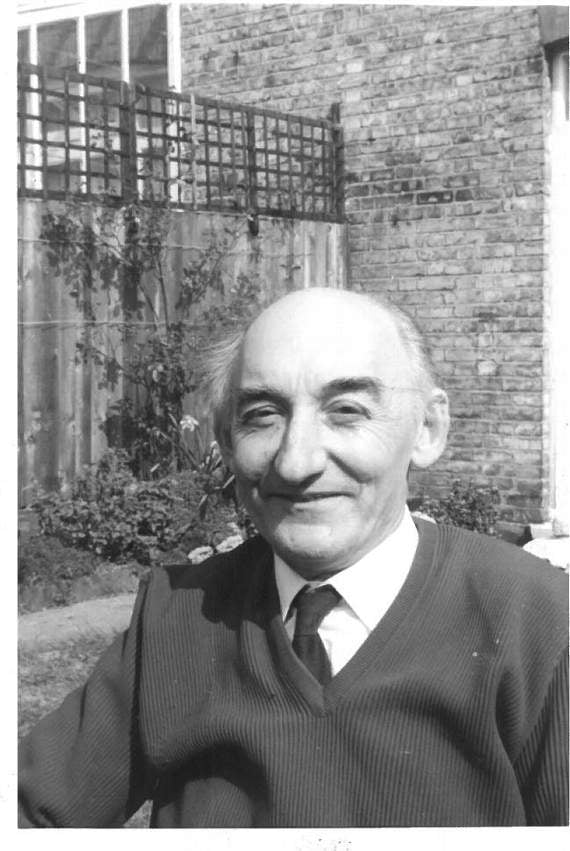
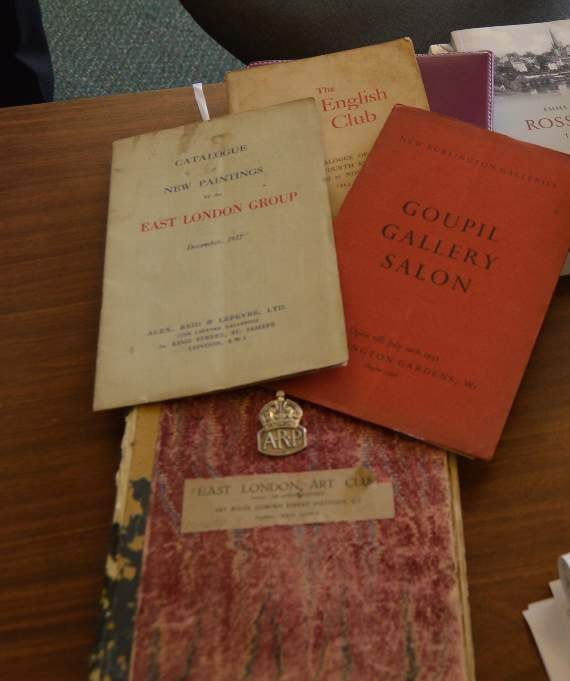
Local resident, and Chairman of the Linton and District History Society, Dorian Osborne, has always been proud of his father’s role as a prominent member of the East London Group of Artists, who flourished during the 1920s and 1930s. Cecil Osborne was secretary and treasurer of the group, and a leading artist whose work was exhibited at prestigious galleries, and was purchased by many wealthy and important people.
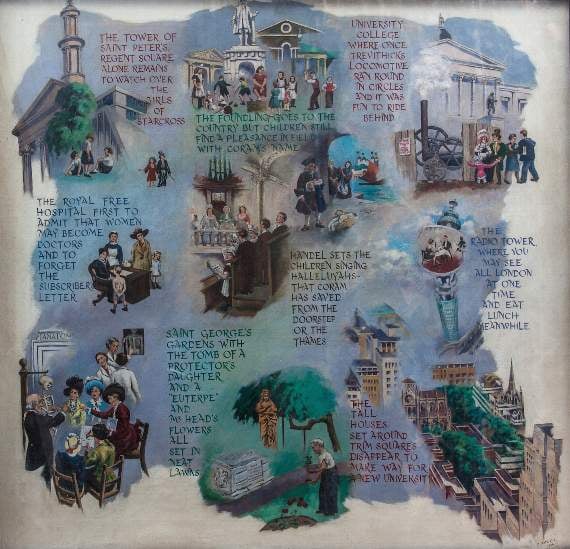
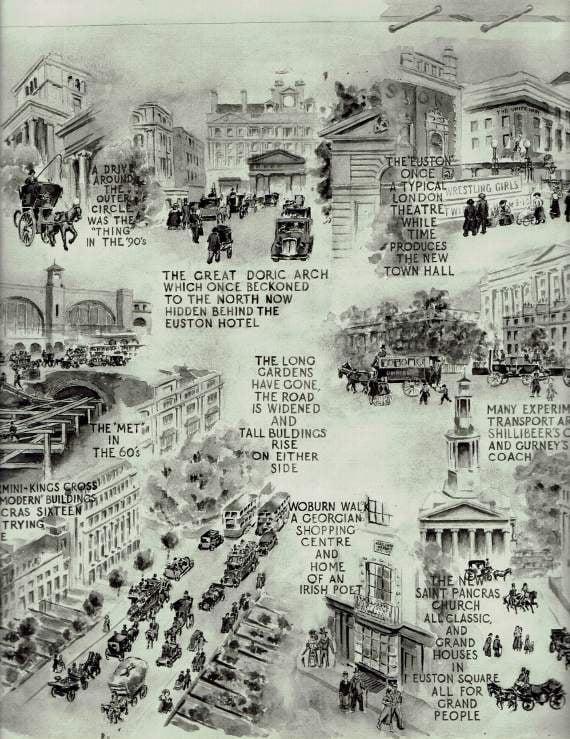
The intriguing story of the rediscovery of three panels, painted to decorate the Town Hall for the Borough of St Pancras, has recently featured in a London newspaper.
The Evening Standard of Thursday, March 8th, 2018 reported that the ‘triptych of large panels from the 1960s, featuring playful oil paintings of life in Camden’ were thought to have been destroyed after vanishing from a council storeroom.
However, they turned up years later behind old furniture at a jumble sale in 1998 when they were bought by Dr Kaori O’Connor, a research fellow at University College London, who spent years attempting to pin down their origin.

Dorian Osborne remembers his father working on the panels in the 1950s when they lived in Belsize Square, London. Work on the first panel was completed in about 1956, and the last was completed in 1965. Dorian and his wife moved to Phocle Green in South Herefordshire in 2007.
He told the Ross Gazette that he is the custodian of the family archive and holds a wealth of material together with a range of paintings, drawings and photographs of both his father’s work and other members of the East London Group of Artists. This includes the minute book of the meetings of the East London Group of Artists, catalogues of sales where Cecil Osborne’s name appears alongside Pablo Picasso.
His work was purchased by many wealthy and important people of the 1930s including Lady ‘Emerald’ Cunnard. In December, 1929, and also December 1930, the Group staged an exhibition at the Whitechapel Gallery which was visited several times by the then Prime Minister, Ramsey MacDonald, and George Lansbury, who remained a keen supporter of the Group.
The leader was John Cooper, whose art evening class, which was the core of what later became the Group, started in Bethnal Green, East London. The members included a basket maker, then much in demand by London Markets, a London Fireman, and a former merchant seaman. However other talented members included Walter Sickert and Phyllis Bray.
The panels were moved by the Council to the Public Lending Library in Brecknock Road, from where they vanished and were saved by Dr O’Connor, probably in 2012. Dorian and his wife have visited her at her flat to see the panels.
The panels feature small scenes labelled with comments, such as “The Royal Free Hospital, first to admit that women may become doctors”. Other locations depicted include the newly built Post Office Tower and the, now demolished, Euston Arch.
Dorian is available to give illustrated talks on the East London Group of Artists, whose work has been the subject of major exhibitions in London, Southend on Sea and, recently, the City Art Gallery in Southampton, where attendance exceeded 10,000.
For more information or to contact Mr Osborne email [email protected]
Comments
We've recently changed our login process. If you have an account for commenting, you will need to re-register on the login window.
This article has no comments yet. Be the first to leave a comment.