

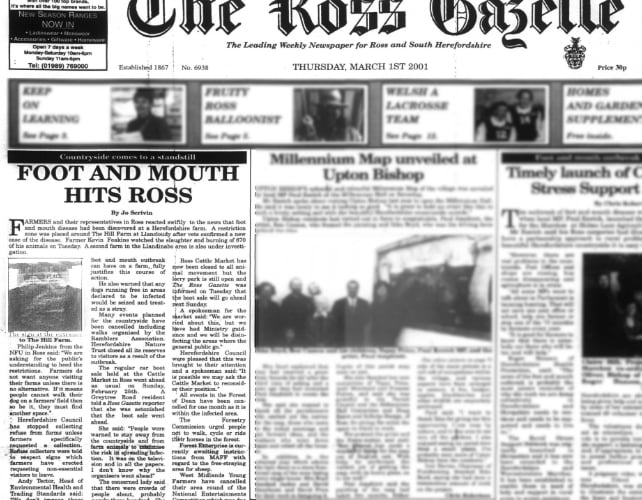
ON the 25th anniversary of the foot-and-mouth disease, many local farmers look back and remember those dark times when thousands of animals were slaughtered and burned on their farms and on those of their neighbours.
The 2001 outbreak originated from pigs at a Northumberland farm fed illegally imported, contaminated meat swill. It spread rapidly due to undetected infections, sheep movements through markets (notably Longtown in Cumbria), and airborne transmission.
The crisis lasted 221 days, resulting in over 6 million animals culled.
When the disease was confirmed in Britain in February 2001, it spread rapidly through animal movements before national controls by the then Ministry of Agriculture, Fisheries and Food were fully in place.




The disease spread across the country, mainly due to the movement of animals by unsuspecting traders buying and transporting animals to markets elsewhere.
Local farmers' worst fears were realised on March 1 with two confirmed cases of foot and mouth disease at Llancloudy and Llangarron.
The first outbreak was at Hill Farm, Llancloudy, run by Kevin Feakins. It is understood that sheep on the farm had been traced to a farm in Devon, where one of the outbreaks occurred.
All the farm's livestock - 270 cattle and 600 sheep - were slaughtered.
The second outbreak was at nearby Trecorras Farm, Llangarron, the home of Steve Watkins. His farm is a mile-and-a-half away from Hill Farm and it is understood that the outbreak was directly linked to that holding.
A further 500 sheep belonging to Mr Watkins, were also killed.
Mr Watkins said at the time that he was doing his utmost to try to contain the disease and added: "This disease can spread so quickly and has taken everyone by surprise,” and he went on to say that the infection was contained in one sheep in a flock on the farm.
A ten-kilometre exclusion zone was placed around both farms.
But by then, it was too late.
Comments
We've recently changed our login process. If you have an account for commenting, you will need to re-register on the login window.
This article has no comments yet. Be the first to leave a comment.