

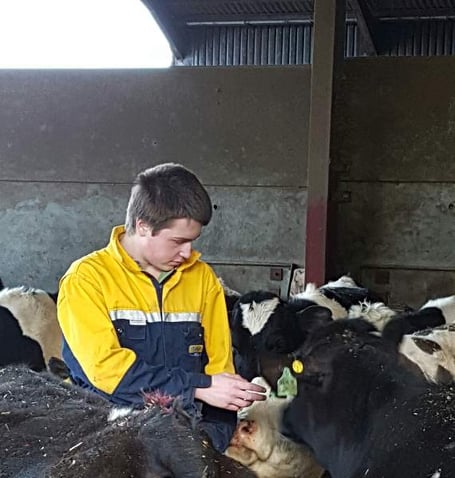
The Davies family, of Hopes Ash Farm, in Hope Mansell, near Ross-on-Wye, is looking forward to a better year in 2018 following a devastating outbreak of bovine tuberculosis (bTB) in May this year.
At the time Robert Davies spoke out about the testing and how the results had impacted on the whole family, emotionally and financially. He kept a detailed diary of the farm’s experience and said he thought it was important to share his experience with the local community and this was included in the Ross Gazette.
At that time 27 in-calf heifers had been destroyed and since the original bTB breakdown in March they have lost a further seven cattle in subsequent tests. Their latest test, in early December, was clear, which indicates that this outbreak may be nearing its end. They need one further clear test in 60 days, followed by a check test in six months to be declared bTB free once again.
However, Robert believes that: “In the absence of any control of the disease in the badger population on our farm, reinfection and the loss of more cattle is inevitable in the future. The unpalatable alternative is to house our cattle inside all year round to keep them safe.”

During the year Mr Davies met with DEFRA and bTB advisors as he tried to highlight the difficult situation farmers find themselves in as compensation paid for destroyed cattle does not fully cover everything farmers lose when cattle test positive.
Aside from bTB, 2017 has been a good year at Hopes Ash Farm. This year the weather has been mostly favourable and the crops have grown well. The winter barley was looking very promising but two weeks of rain in July, just as it was ripe and ready to combine took its toll, however, the winter wheat, spring beans, grass, maize and apples all yielded very well. Mr Davies said: I would like to say this was as a direct result of our excellent farming, however, the weather has a massive effect on the success, or not, of our crops throughout the year.”
He is still concerned about milk prices. He said: “After more than two years in the doldrums, with many farms being paid less for their milk than it costs to produce, milk prices have finally recovered during the latter half of the year to a more sustainable level. Although there is already talk of price cuts early in the new year.”
In addition to bTB, the Brexit process is his main concern for 2018, whatever the outcome, he believes the system of agricultural support farmers receive will change. He said: “Whilst I’m not a particular fan of agricultural subsidies; farming is a risky, expensive and long-term business and, without some form of financial protection, some sectors of our industry may struggle to survive. This will have an impact on food supply, local economies and the landscape which we enjoy. I fear our supermarket shelves will bulge with cheaper imported food, produced to lower welfare and environmental standards, whilst UK farmers will become nothing more than curators of our green and pleasant land.”
Comments
This article has no comments yet. Be the first to leave a comment.