

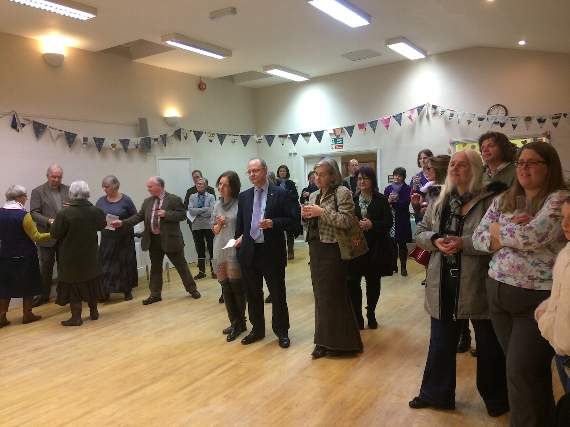
Dozens of people visited Lea Village Hall on Friday, November 18th, to show their support for Phocas; a new social enterprise project, aimed at giving ex-offenders and homeless people horticultural skills, while also producing locally growncut flowers.
Simon Tarlton had the idea for Phocas, and with the help of his fiancée, Caroline Griffiths, the project has grown. On November 18th, Phocas was formally launched.
Simon is also a part-time curate at St Mary’s Church in Ross-on-Wye. At the launch evening, he told the project’s supporters that Phocas was the comibation of three factors: personal experience, the desire to help ex-offenders and those affected by homelessness, and a passion for the British cut flower industry.
He said that when he was a young man, he was at risk of becoming homeless, but he said that everything changed when he got in to horticulture. “Gardening saved my life,” he said.

He explained that during the formation of Phocas, he had approached similar already-established organisations for advice, and he introduced Lorraine Preece, the Chief Executive of YSS; who he said he was immensley grateful to for her guidance and support.
Ms Preece explained that YSS is a charity providing community based support services for children, young people, adults and families, in West Mercia and Warwickshire, who are vulnerable, have complex needs and who face difficult life challenges.
She said that during the formation and finalisation on the project’s plans, her role was to act as a “critical friend”, to help Simon to create the Phocas business model.
Ms Preece said: “What I love about Simon is his passion, desire and enthusiasm to do something, and how quickly he’s gotten it [Phocas] off the ground.”
She added that Phocas would be very theraputic for the volunteers. In her line of work, she has seen that working on the land, in the fresh air can be invaluable in getting people to turn their lives around.
Simon finished off the meeting, by saying that Phocas was a social enterprise, not a charity, and they hope to be self-sufficient by the beginnig of the third year.
He said they would start by taking small numbers of people, mentoring them into long-term sustainable brighter futures.
Comments
This article has no comments yet. Be the first to leave a comment.