

Author, John Lewis-Stempel, whose latest book, Where Poppies Blow: The British Soldier, Nature, The Great War, won the 2017 Wainwright prize for nature writing, was inspired by Edward Thomas, one of the Dymock poets.
And in his recent article in The Guardian, he explains why he considers Herefordshire in the same way as Thomas who became besotted with Herefordshire, where “the land was sweet”.
Thomas walked around Dymock, Much Marcle and May Hill many times and for him, Herefordshire was “This England”, and his love for it imposed a duty of protection. John Lewis-Stempel intends to walk along the lanes, following the Poets’ Paths in Dymock as his own pilgrimage to Thomas, soldier and nature lover.
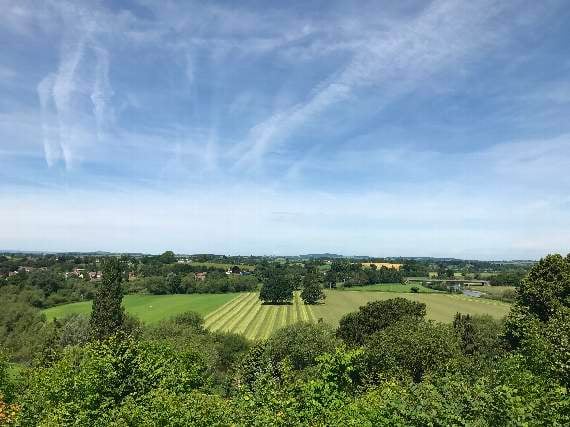
The author’s family have lived in the County of Herefordshire for 800 years and he describes it poetically. He said: “The west of the county is peregrine-stooped upland. The Black Hill, beloved of Bruce Chatwin and wilderness walkers, soars to 640 metres. The east is pastorally perfect: rich green fields for the famous Hereford cattle, and fertile red earth for hops.”



The Mappa Mundi, a map of the world drawn in the 1300s which includes few places, but does include Hereford, as John said: “Well, it is heaven on Earth.”
He also describes the black-and-white Tudor villages north of Hereford, and the many churches that can be discovered all over the county. But he considers the area around Ross to be ‘as lovely as the Dordogne’, especially if you take the secret riverside lane through the hamlet of Hole-in-the Wall to Ross-on-Wye. “From a distance, Ross seems pinned to its red cliff by the needle steeple of St Mary’s.”
Many of the comments seem to be in agreement with Mr Lewis-Stempel, although some question his county boundaries. Dymock is in Gloucester, but as Ross is surrounded by other counties and countries, nestling as it does in its own micro climate it is not surprising that he inspires such strong feelings.
Comments
This article has no comments yet. Be the first to leave a comment.