

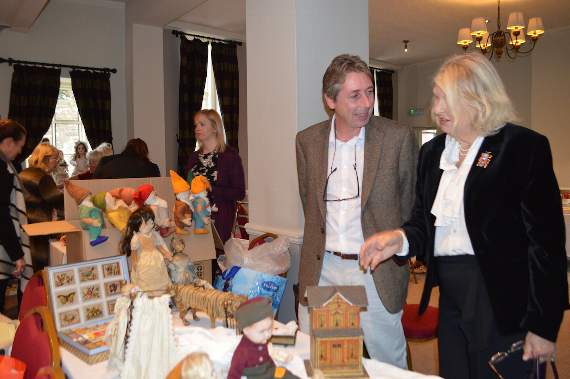
Well-known antiques consultant and author, paticularly in the world of toys and dolls, Constance King, from Ross-on-Wye, recently organised a meeting of dealers and collectors to discuss the future of the antiques trade.
She told the Ross Gazette: “The symposium covered a vast area with many comments worth further discussion. Everyone loved the venue and wants to participate again.”
A commitment to the world of antiques characterised the dealers, auctioneers and collectors who met at the Royal Hotel in Ross-on-Wye to focus on the state of the collectors market in Britain. The absence of young people from the salerooms and antiques fairs was central to many discussions with almost everyone feeling that the inculcation of multi culturalism has stripped away that pride in our nations past, its traditions and craftsmanship, that fostered a desire to own fine furniture and assemble collections.
The symposium was organised at the request of several specialist dealers and collectors who felt that their interests and opinions carried no weight with auction rooms and the media where the concentration is only on monetary value. Organised and chaired by Constance King, who has written extensively on antiques for many years, and also works as an auction room consultant, the event was non profit making with both delegates and speakers sharing costs. All attended because of their concern for the antique toy market though much of the discussion related to the antiques trade as a whole.


The speakers included Lee Gotch who, at Bonhams, had auctioned a record breaking collection of rare dolls, Collett Mansel who has written several books on English made dolls, Sue Pearson whose teddy bear shop in the Brighton lanes was a legend, Tracie Vallis who has worked both at Bonhams and Chiswick Auctions and Constance, talking about an 18th century dolls house. Other participants included Mo and Steve Harding who have run a shop in Chester for decades, representatives of the Doll Collectors Club of Great Britain, the Worcester Doll Club and a number of individuals who either dealt in or collected toys. Five of the participants had attended the first British Doll Collectors Conference that was held at the Metropole in Brighton in 1979, a grand affair that incorporated a fair and an auction. At that time antique toys were highly fashionable and the conference attracted all the leading auction houses as well as delegates from most European countries. Britain was at the centre of the European toy trade but, in recent years, France seems to have taken the lead.
Toy collecting has a respectable pedigree .In the 19th century there were a number of collectors though they were often academics or artists. The 20th century interest in the traditions and psychology of childhood encouraged many museums to build up collections while there were exhibitions and an increase in the number of individual collectors. There were doll clubs in America and France before the war with the doll club of Great Britain starting a few years later. The antiques trade took off in the 1960s and 1970s when acquiring anything old became a virtual mania fed by books, magazines, fairs and specialist shops. Prices shot up so that items could be sold at a profit within months.
In a discussion of why collecting had become so popular and why they were personally attracted, everyone agreed that an interest in history was most important though they also enjoyed sharing knowledge. The social, interactive character of the antiques scene was also enjoyed. The enthusiasm of dealers, the thrill of the chase, the competition and the investment element had all encouraged people to collect or deal. Several were lured by the glamour of the scene with its many eccentric characters, a time when even auctioneers had individuality.
A discussion of why the antiques scene has stagnated in recent years with prices for furniture in particular falling, several felt that what was perceived as the scam of limited editions and reproductions worth very little when re-sold, had damaged the lower end of the market. Several dealers remarked that the character of collectors has also changed. People were once pleased to acquire pieces steadily, learning as they went and making friends with other collectors. Today some come briefly into the scene, buy expensive pieces they do not understand and drop out, hurt when they lose money. Day time antiques game programmes on television were castigated as they were felt to trivialise the trade, are only concerned with value and often present damaging, incorrect or misleading information.
The recession and limited living space have formed a barrier for young people but the trade boomed in the recession of the 1970’s and several people said they had begun collecting when they lived in single rooms and earned very little. One dealer remarked that the antiques market has, pitted against it, huge commercial manufacturers, spending heavy money on the promotion of new furniture and artefacts and, through advertising, persuading people that new and disposable is more fashionable than fine and old. Generally, it was felt that, at a time when culture, learning, eccentricity and aestheticism are not valued, antique collecting, perceived as both strange and elitist is out of favour.
Damage has also been caused by changes in the auction rooms and publishing instigated by the results of opinion poles and focus groups that deliver results at odds with the wishes of specialist consumers and result in damaging decisions. Auction rooms were much criticised, with the usual grumbles about commission rates and a lack of interest in the needs of their customers. Too many auction rooms were felt to be accountant led with some auctioneers who seem to know nothing about antiques and exhibit their lack of interest. One delegate commented on how the selling rate in toy sales increased when the auctioneer knew something of the subject.
Several of the dealers present traded on line and enjoyed the wide market that was on offer while the many web sites that provided information and images were also appreciated. It was noted that some of the highest prices paid at auction were from people who, contrary to current belief, did not even own a computer. Several stated that they could no longer survive without selling on line even though they felt it was not “proper dealing.” In general sales internet sales were to established collectors with few completely fresh clients. However, younger delegates felt that the internet was the way to attract young people and could be used to greater effect.
For many years, while the price of furniture has tumbled, antique toys and dolls were little affected. The cold wind that damaged so much of the middle range market hardly touched this area but, in the last five years, the collectors scene has suffered resulting in fewer auctions and fairs and a lack of new enthusiasts.
The symposium was organised to identify problems and consider methods of re-invigorating the scene. Fortunately, there are still many people making a living out of dealing, there are still auctions and doll and toy clubs and a few magazines. There are still many buyers for rarer items and interest in antique dolls houses in particular is strong. There are several encouraging trends: a new toy fair is to be held at Olympia next year, several provincial auction rooms have set up toy departments, an exhibition of dolls houses was held in Bath and the next Kensington Doll fair will incorporate an auction.
The fact that the Symposium was organised is an element that could lead to similar self funding events incorporating dealer to collector bring and buy sales. (In this instance there were many fine items on offer from £10-£3000). Obviously, the antiques trade is influenced by fashionable trends and anyone investing for profit has to take hits as well as gains but many people still enjoy the scene.
After a day of lively discussions by a group of Britain’s leading dealers and collectors some suggestions emerged. It is necessary to put glamour and eccentricity back into the scene, auction rooms need to be more user friendly with sales starting later so viewing can take place in the mornings with people staying on to bid in person. To attract young buyers there should be a wide price range as interesting objects are not always expensive. There should be more specialist events around the country as at present, everything is London orientated. Groups, clubs and dealers could stage small exhibitions so people can see actual examples. Museums should be encouraged to exhibit their antique toys and use fewer visual aid type boards, When organisations get it wrong dealers and collectors should complain in writing . There was a general feeling that, in recent years, buyers had been poorly treated and lightly considered causing people to leave the scene. The antiques world is a vast pyramid and it is in our interest to preserve the complete structure , the small buyers at the base being essential to the health of the whole.
Comments
This article has no comments yet. Be the first to leave a comment.