

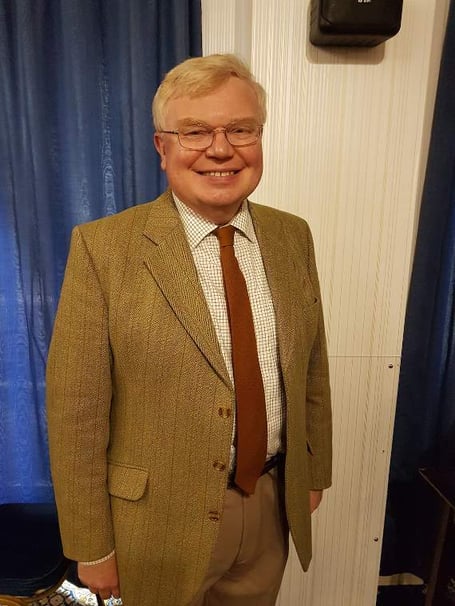
The Gloucestershire Regiment in Europe, 1944-45 was the title of an excellent presentation by guest speaker, Dr Tim Brain, to the Kyrle Probus Club at its recent meeting. And intrinsic to the story of the Glosters at that time, was ’Uncle Gilb.’
He was Gilbert Brain, a great uncle to Tim, who used the material he had been able to collect about his relative, to trace the activities of the Glosters in the campaign in North West Europe in World War II. Uncle Gilb in fact was awarded the George Medal for his service in this period, but he did not let on about it and the family did not know how he came to earn this honour. They only knew he was presented with it by Lord Montgomery.
The Gloucestershire Regiment, was a line infantry regiment with a long, distinguished history. The Regiment was formed by the merger of the 28th Regiment and the 61st (South Gloucestershire) Regiment of Foot. Its distinctive badge bears a Sphinx and it inherited the privilege, unique in the British Army, of wearing a badge on the back of its head-dress, as well as the front. The honour was won by the 28th Regiment when its men fought back to back at the Battle of Alexandria in 1801.
In 1944, the 2nd Battalion transferred to the 56th Independent Infantry Brigade and fought in the allied campaign in North West Europe. On June 6th it landed on Gold Beach as part of the second wave of the Normandy landings. The Battalion captured Bayeux, but at Tilly-sur-Seulles, they took heavy casualties and had to withdraw.

While his comrades retreated, Uncle Gilb stayed in his position, deliberately showing himself and firing his gun from the hip at the enemy, before also retreating. On the way he came across a fellow soldier caught in barbed wire. Uncle Gilb released the soldier and carried him to safety, using a fireman’s lift. It is believed it was this action that won him the George Medal.
In mid August, the 56th Brigade joined with the 49th West Riding Infantry Division, and continued the sweep across Normandy to the River Seine. It was tasked with taking Le Havre and on September 12th, it was the first British unit to enter the city’s fort, taking some 1,600 prisoners in the process.
After Le Havre, their objective was to take sea ports up to Antwerp and by the end of November, Antwerp itself was taken. The Battalion’s last significant action came in April 1945, when it crossed the river Ijssel at Arnhem, after which, the rest of the 56th brigade passed through to capture the town itself.
And what of Uncle Gilb? Tim explained that after being part of the Army of occupation, he returned home to carry on a successful business career.
Comments
This article has no comments yet. Be the first to leave a comment.