

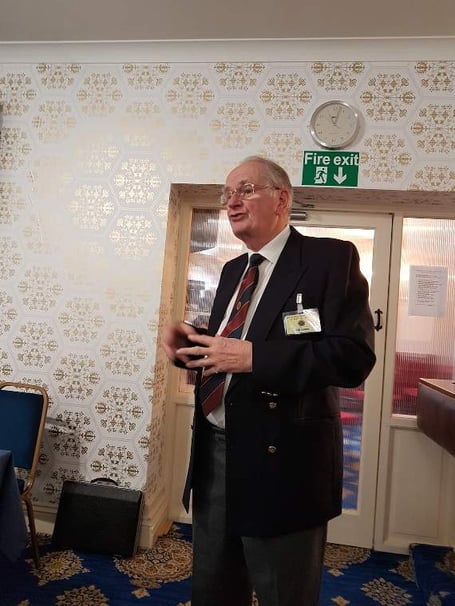
Kyrle Probus Club member Bill James gave the first talk of the New Year to the Club on ‘King John I and the year of the Magna Carta 1215.’
The talk initially focused on King Henry II and his wife, Eleanor of Aquitaine, who had eight children, three girls; Matilda, Eleanor, and Joan, and five sons; William IX, Henry ‘the young king’, Richard I King of England, Geoffrey II, and finally John I, King of England. As the fifth son, John was not expected to inherit significant lands.
However, Henry, Richard and Geoffrey all rebelled because Henry II bequeathed three castles to John as part of his marriage arrangements. Others joined the rebellion, upset at Henry II’s possible involvement in the assassination of Thomas A’Becket, Archbishop of Canterbury.
John’s elder brothers, William, Henry and Geoffrey all died young and when Richard I became King in 1189, John became heir to the throne. In 1189 John married Isabella of Gloucester. When Richard l died without children in 1199 following the crusades, John succeeded to the throne and his first marriage was annulled. He needed a male heir and married 14-year-old Isabella of Angouleme a year after the annulment.


John inherited a large part of France through his marriage, but keeping control of his empire was very costly, and during his reign he lost most of the land. John also angered the barons and knights by imposing taxes to pay for wars he ultimately lost, particularly in Northern France.
King John’s falling out with the Catholic Church developed when in 1205, Archbishop Hubert died, and the monks secretly elected one of their own. King John and the Bishops refused to accept this election, and nominated John de Gray, Bishop of Norwich, in his place. Pope Innocent III refused to accept either nomination and appointed Stephen Langton to be Archbishop of Canterbury. King John declared that any person that supported Stephen Langton was a public enemy. The Pope then issued an interdict which banned all church services including marriage and funerals. As the row deepened, the Pope excommunicated the King.
A peace deal was eventually agreed in 1213 when the king yielded. At a meeting of churchmen at Westminster in August the Archbishop read the text of the charter of Henry I and called for its renewal. His energetic leadership, and the barons’ military strength, forced King John to grant his seal to the Magna Carta on June 15th, 1215 at Runnymede, near Windsor, which limited his power.
Bill said that the Magna Carta contained 63 clauses when it was first granted, but only three clauses remain part of current English law. One defends and defines the rights of the English church. Another confirms the liberties and customs of London and other towns. Bill closed his talk with the third and the most famous clause.
“No free-man shall be seized or imprisoned or stripped of his rights or possessions or outlawed or exiled or deprived of his standing in any other way, nor will we proceed in force against him or send others to do so, except by the lawful judgement of his equals or by the law of the land. To no-one will we sell, to no-one will we deny or delay right or justice.”
Comments
We've recently changed our login process. If you have an account for commenting, you will need to re-register on the login window.
This article has no comments yet. Be the first to leave a comment.