

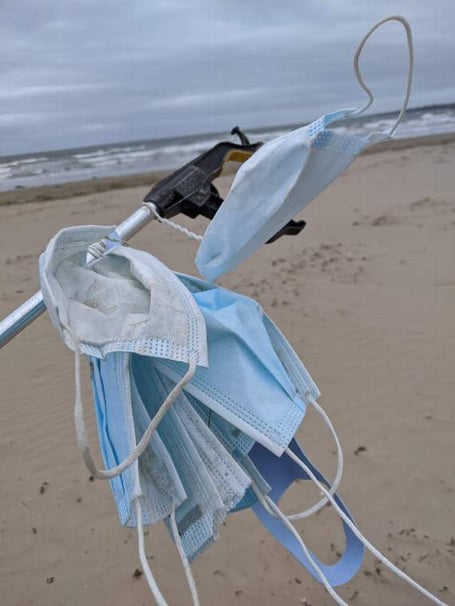
A CONSERVATION charity that organises an annual nationwide beach and river bank clean up says large numbers of face masks and gloves were found this year.
Litter created by the coronavirus pandemic was picked up by volunteers taking part in September’s week-long Great British Beach Clean and Source to Sea Litter Quest, according to the Ross-on-Wye-based Marine Conservation Society.
A spokesperson said: “The results from this year’s Great British Beach Clean (GBBC) show a concerning, but perhaps predictable, presence of PPE litter.
“Face masks and gloves were found on almost 30 per cent of beaches cleaned by Marine Conservation Society volunteers over the week-long event.




“The inland Source to Sea Litter Quest data shows a similarly worrying presence of masks and gloves, with more than two thirds (69 per cent) of litter picks finding PPE items.
Lizzie Prior, GBBC coordinator at the Ross Park-based charity, said: “The amount of PPE our volunteers found on beaches and inland this year is certainly of concern.
“Considering masks were only made mandatory a matter of months ago, the spike in their presence on our shores is worrying. Whilst we continue to battle with the ongoing presence of other single-use litter, PPE pollution cannot be part of our new normal.”
Like many other single-use items, disposable face masks and gloves pose a threat to wildlife on land and at sea, she added.
Marine animals can mistake face masks and gloves for prey, filling their stomachs with materials which will not break down and could prove to be fatal.
Animals also risk being tangled in the straps of face masks, with seabirds’ feet pictured recently being wrapped in the elastic strings.
The River Wye that flows through Ross meets the sea some 36 miles downriver on the England and Wales border.
Across the week of the Great British Beach Clean, more than 3,000m of Welsh beach was cleaned and surveyed during 32 events, with 143 volunteers getting involved, including Welsh First Minister, Mark Drakeford.
An average of 237.5 litter items were found per 100 metres of Welsh coastline, with small plastic pieces remaining the most common form of litter, an average of 92.4 pieces being found per 100m of beach.
Gill Bell, Head of Conservation Wales at the MCS, said: “This year’s results show the persistent problem of plastic on Welsh shores.
“Every year, small pieces of plastic remain the most commonly found item on our beaches having broken down from larger plastic items. By banning certain single-use plastics and introducing policies which prioritise reuse, we can turn the tide on plastic.
“We welcome the two recent consultations by the Welsh Government: Beyond Recycling and a ban on some single-use plastics.
“We hope the government takes notice of the public’s views and develops ambitious policy on deposit return systems and extended producer responsibility.”
The top five most common litter items on Welsh beaches in 2020 (average per 100m of beach surveyed) were:
1. Plastic and polystyrene pieces (0-50cm) – 92.4
2. Plastic string – 21.9
3. Plastic and polystyrene caps and lids – 17.8
4. Plastic and polystyrene packets (crisps, sweets and sandwiches) – 14.3
5. Cigarette stubs – 9.5
For more information, visit the Marine Conservation Society’s website at www.mcsuk.org
Comments
This article has no comments yet. Be the first to leave a comment.