
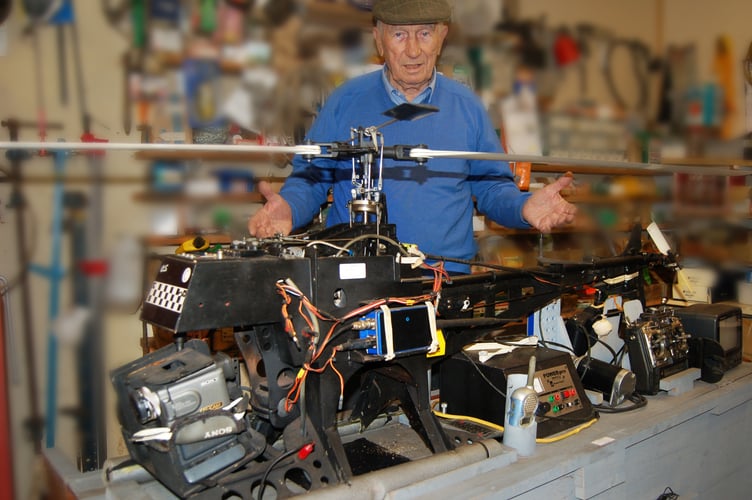
THE ‘Top Secret’ status on the original concept and development of drones has been lifted, enabling its local inventor to reveal all.
Robert Channon, 81, from Walford explained that his development of the drone can be traced back to his time working for the water authorities during the 1970s when he produced robots to aid keeping the network system clear.
This in turn led to Mr Channon designing, building and flying unmanned helicopters which could be used to seek and destroy land mines, but this process took a number of decades to come to fruition while he mastered the techniques behind the gyroscope, which gave generated lift using an unpowered, free-spinning rotor system.
Mr Channon said that he spent a lot of time in nature, especially watching dragon flies and added: “It seems that bees and other insects have energy saving phenomena by creating static on the stroke of their wings.




“But I soon realised dragon flies gleaned energy from the upward wing direction, and I tried to emulate the dragonfly flight in my design.
“The early inventions were difficult to fly as the machines, just like the real helicopters, didn’t have any gyroscopic technology on board.
“But over time the gyro technology was introduced into my design and consequently I went on to demonstrate this early phenonium at many airshows, especially at Parc Aberporth in West Wales, where it was a centre of excellence.
“Later, I was challenged to get a clear photograph of a certain area using a radio-controlled helicopter. I believe I took some 15,000 photographs before I perfected this technique of getting the drone horizontal and capturing a sharp image.”
And when it came to developing the land mine detector, Mr Channon had to devise a technique that didn’t use a magnetometer as most devices were made of plastic and turned to the thermal signature as this would vary from the earth surrounding the device.
“If an unmanned helicopter equipped with a television camera and transmitter could fly over the area where anti- personnel mines had been buried just below the surface, it produces a different signal from its surroundings,” said Mr Channon.
However, it was not always possible to determine that it was an anti-personnel mine, but the readings could confirm that it was alien to its environment.
Mr Channon continued: “And when the unmanned helicopter demonstrated that iyt could successfully handle detecting anti-personnel mines and photographing the area with crystal clear vision, the army suddenly became interested in the prototype drones, and the project immediately became top secret in the early 2000s.
The drones that are produced today are a different beast as Mr Channon’s initial designs as they were adapted in America by boffins who replaced some of the onboard gyroscopes with rotary blades, which gave the operator more control.
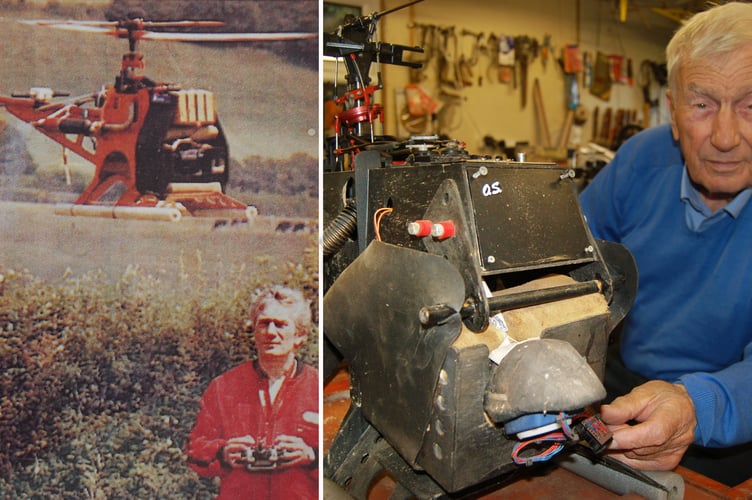
“But basically, the drone today is basically the same piece of kit as I designed. I didn’t patent the drone, even though I had thought about it. However, the drone has come a long way from the early conceptual designs.”
Comments
We've recently changed our login process. If you have an account for commenting, you will need to re-register on the login window.
This article has no comments yet. Be the first to leave a comment.