
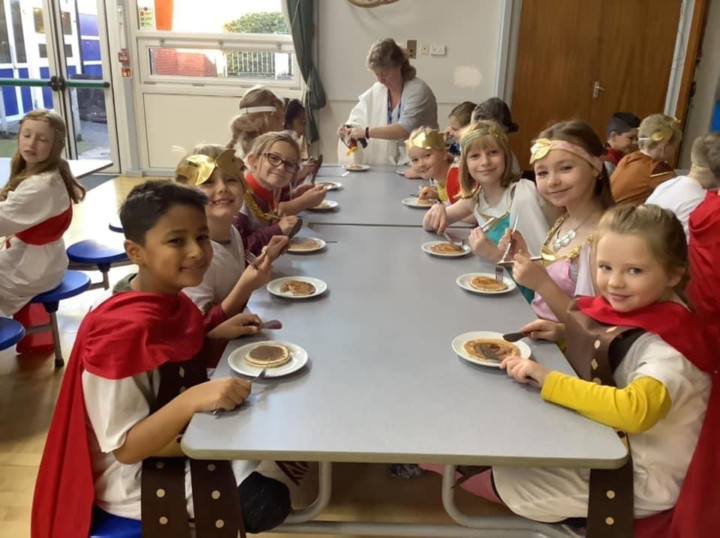
PRIMARY school youngsters have taken a trip back in time to the days of the Roman Empire.
As well as dressing in Roman costume, Year 4 pupils at Ashfield School in Ross-on-Wye have been trying their hand at all manner of ancient skills as well as visiting the remains of a villa.
Travelling back to the days of centurions and gladiators was all part of this term’s Roman Empire topic.
Things kicked off with Roman Day, as children came to school dressed in the togas and togs of 2,000 years ago before starting the day with a traditional breakfast (ientaculum) consisting of a pancake and honey.



They then participated in a range of Roman-themed activities, making clay thumb and mosaic pots, cooking up a menu for a Roman feast, preparing dishes, designing an aqueduct and trying out Roman marching drills.
A few days later, all the Year 4 children headed for Chedworth Roman Villa near Cheltenham, one of the largest and most elaborate villas so far discovered in Britain and one with the latest occupation beyond the Roman period.
They explored the grounds of the villa, built in phases between the 2nd and 5th centuries, had a guided tour and made their own mosaics after learning about the process from the guides.
The children were thrilled by the opportunity to travel back in time, Oscar saying: "It was very exciting because I could imagine what it was like when Romans lived here.
"I think it was really good because there was so much to see and I loved seeing all of the parts of a real Roman Villa. I really enjoyed it," added Lyla.
And Sangahvi said: "I really enjoyed it because I learned a lot more about the Romans. My favourite part was when we got to make our own Roman mosaics."
Discovered and first excavated in the 1860s, the 4th century construction transformed Chedworth into an elite dwelling arranged around three sides of a courtyard, including a heated and furnished west wing containing a dining-room (triclinium) with a fine mosaic floor, as well as two separate bathing suites: one for damp-heat and one for dry-heat.
Comments
This article has no comments yet. Be the first to leave a comment.