

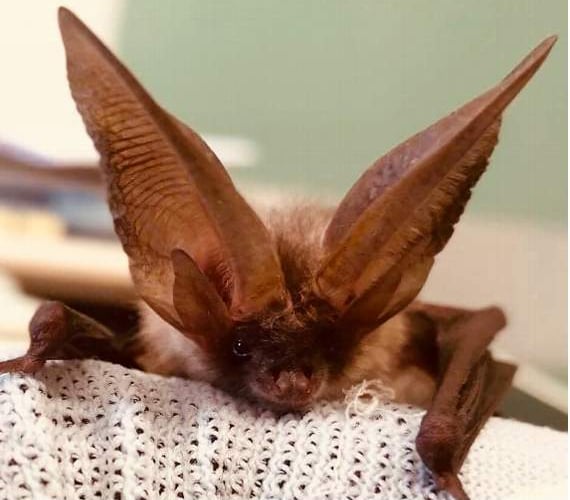
When a brown long eared bat was found face down and soaking wet on a pavement in Broad Street, Ross-on-Wye, there was little hope for his future.
However, thanks to a call to Leigh Russell, the bat lady from Hom Green, Barney is recovering well and is in the process of being prepared for release back into the wild. He has already spent some time in an outdoor home to get him used to the temperature, sounds and environment until he is ready for full release when the nights have warmed up.
Leigh has hand fed and protected Barney from that first night when he needed feeding every couple of hours, until he is ready to look after himself. He has now travelled to the Devon Bat Group, where they have a purpose built shelter where there is room for Barney to learn to behave like a bat. He will have space to fly and find the insects he needs, but for a couple of weeks will still have some protection.
He has been fed on meal worms but in the wild he will need to find insects himself, up to 3000 every night.


Leigh said that lots of bats have been found in Ross in the Broad Street area so she thinks there is probably a colony there. But she said this is not a problem, bats and humans live well together and because they eat mosquitoes and insects they actually do humans a favour.
She said it is also probably why they are found near street lights as they love moths and as moths are attracted to light they hunt them there.
Leigh said Herefordshire is particularly lucky for anyone, like her, who is interested in these mammals. Out of the 18 species in the UK, 16 are found in the county. And Leigh busted a couple of popular myths, most bats do not hang upside down, only one species does this in the UK, and they do not get tangled in people’s hair, their extraordinary ability to locate food or obstacles is due to their ability for echolocation. They emit sound waves from their mouths, when these hit an object the sound bounces back and returns to their ears so they hear them.
Since World War I the numbers of bats have been in rapid decline. This has been due to several factors, such as the increased use of pesticides which means there are less insects for them, also as barns and churches are converted to homes for humans there is less space for bats to feel at home in.
As Leigh explained bats are happy to co-exist alongside humans but what they need is a place with a stable temperature. They prefer the warmth but what they hate is fluctuations. That is why there are so many living in caves in the Forest of Dean. She also explained why there is no need to be alrmed if you are doing building work and come across a colony. She said they are protected but with the right help and advice it is easy to find a solution for everyone.See the full story in this week’s edition of the Ross Gazette, or subscribe to our online edition here
Comments
This article has no comments yet. Be the first to leave a comment.