

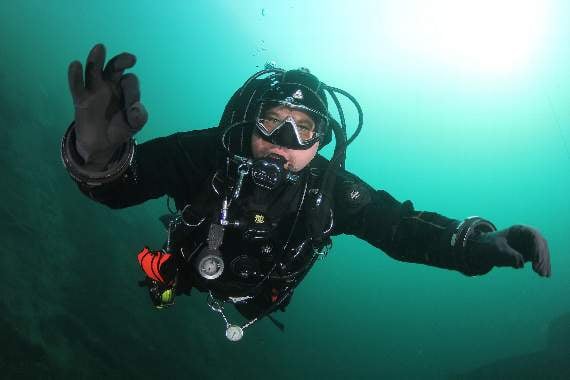
A passionate Symonds Yat scuba diver whose brain injury ended his career has been shortlisted for a national award.
James Neal’s brain injury drastically changed his personality and turned his life upside down. However, his passion to scuba dive once again has helped him to turn his fortunes around.
Now, he has been named as one of three finalists for Headway - the brain injury association’s Alex Richardson Achiever of the Year Award, sponsored by Slater and Gordon Lawyers.
James said: “When I found out I was a finalist I was lost for words. To hear that I have inspired other people is just seriously cool.”


Days before Christmas 2013, Dimple Neal arrived home to find her husband unconscious on the floor having suffered a subarachnoid haemorrhage, a bleed on the brain.
James, 49, was rushed to Frenchay Hospital, where he underwent immediate surgery to stop the bleed, while his loved ones were told to prepare for the worst, he was not expected to survive the night. He was left with short-term memory loss, had difficulty thinking logically, making decisions, and being rational.
He struggled to find his words and was overwhelmed with fatigue. He could no longer run his business, and his marriage was pushed to the limits.
Dimple said: “He quickly became angry, having outbursts that I thought would end our marriage. The dynamics of our relationship had completely changed and we were struggling.”
James’ inability to filter his thoughts made him blunt and direct and as a result he was kicked out of one of the two diving clubs he attended, shattering his confidence.
Crushed and reduced to tears, James took a huge step back in his recovery. He said: “People knew I had sustained a brain injury but because I looked fine they were unwilling to accept that I was struggling. That’s the problem with brain injury - it’s a hidden and fluctuating disability.
“My wife says everyone else gets nice James, while she’s at work, but she comes home to the fall out. I struggle to manage my fatigue and emotions, it’s like Jekyll and Hyde. My wife is remarkable, I don’t know how she does it. I love her to bits.”
James said: My neurological doctors didn’t know anything about diving, and my diving doctors didn’t know anything about brain injury, but I put them in touch with each other and I’m really grateful they worked together to support me.”
Although James lost many of his life skills as a result of his brain injury, his knowledge of diving was still there.
He said: “As a result of my injury, I can only focus on one thing at a time. When I’m diving I focus on that and everything else is gone. On dry land there are always too many things going on at once and I can’t focus on doing anything.
James is now among the top 1% of divers world-wide, with no limit to the depths he can dive to.See this week’s paper for more stories like this, available in shops and as a Digital Edition now.
Comments
This article has no comments yet. Be the first to leave a comment.