

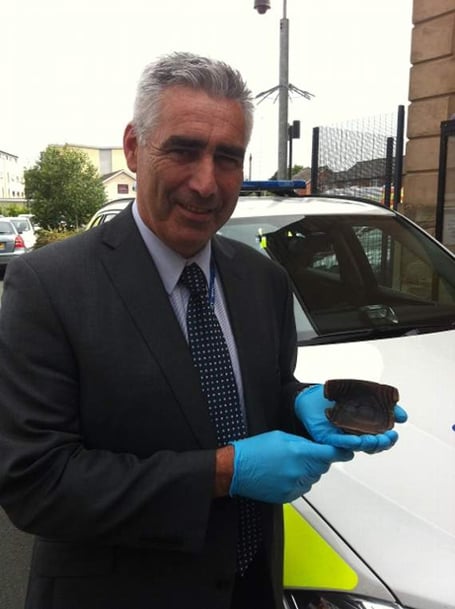
A religious relic, which was owned by a local resident, is on permanent display at the National Library of Wales.
The Nanteos Cup, which for many years was believed to be the Holy Grail, was recovered by police after it was stolen last year during a burglary in Weston under Penyard. The investigation into the incident was featured in the national media and there was an appeal on BBC One’s Crimewatch. As a result the police received several significant lines of inquiry which led to its recovery.
It has now been donated to the Library in Aberystwyth where thousands of people are expected to view it over the coming months.
The exact origin of the Cup is a mystery, but according to tradition the relic came into the possession of the Powell family of Nanteos, in Wales, from Strata Florida Abbey during the Dissolution of the Monasteries. It is believed that seven Cistercian monks escaped from the Abbey with the Cup and sought refuge at Nanteos. Following the death of the last of the brothers, the Cup was left to the family and has been treasured and preserved ever since.




Nanteos mansion was sold in 1967 and the cup was taken to Ross-on-Wye where the family made their new home.
Pedr ap Llwyd, Director of Collections and Public Programmes at the National Library of Wales said: “At last this much revered ancient relic has returned home to Ceredigion and Wales and placing it on permanent display will allow visitors to the Library to view this mysterious object. This is truly a remarkable object and a very interesting addition to the National collections. We are grateful to the Mirylees family for entrusting the safekeeping of the Cup to the National Library”.
Since the 19th century it has been claimed that the Cup possesses a supernatural power to heal. The Cup would be lent to the unwell in exchange for a valuable deposit such as a gold watch or coins, as to ensure its safe return to Nanteos. The patient would normally drink from the Cup, however it is thought that many nibbled the wood hoping to increase its so-called mystical effectiveness.
Comments
This article has no comments yet. Be the first to leave a comment.