

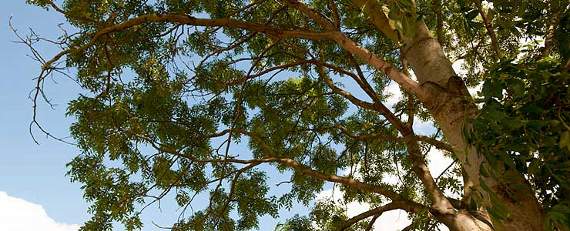
Residents of Fownhope have been warned on their village website about the danger of a new tree disease, called Ash Dieback, and what it may mean to their landscape.
Ash Dieback is a fungal disease, which is new to this country, and it is thought that over 97% of Ash trees will eventually die as very few show strong signs of tolerance to the disease.
Ash Dieback has now been confirmed in several locations in Herefordshire. There will inevitably be a significant loss to our local landscape and wildlife.
This will also come with an element of risk from Ash trees that are growing near buildings, roads or other tracks as they gradually succumb to the disease.


For this reason, a survey of the Ash trees within Fownhope has been started, focusing initially on the village itself and roads and trackways which service it. This should hopefully help the Parish Council and other landowners become more aware of the Ash trees in the locality and monitor for the arrival of the disease.
If you would like to assist the Parish Tree Warden in undertaking the annual Ash tree survey then please contact him on 01432 860438 or email [email protected]
Ash grows well on the limestone soil of the Woolhope Dome and is a very common tree in our parish woodlands. Young saplings and trees have smooth grey bark, but the bark becomes more fissured with age. Each leaf is made up of 6 - 12 leaflets in opposite pairs (a compound leaf) with a single terminal leaflet at the end of the leaf stem.
In the winter the Ash tree can be identified by having large diamond shaped black buds carried in opposite pairs on flattened grey twigs.
How to identify Ash Dieback
The fungus that causes the Ash Dieback disease is known as Chalara. Airborne Chalara fungal spores infect the leaves of the Ash tree and cause them to wilt earlier than would be expected, and eventually fall from the tree.
You can look out for the wilted leaves during July and August. The fungus enters the branches of the tree, and the crown of the tree will start to dieback.
At the point where the leaf or young shoot grows from an older stem, there is usually a darkened lesion. The bark lesion is diamond shaped and runs above and below the stem attachment point.
The Forestry Commission website, available at www.forestry.gov.uk, gives a detailed account of the disease. Also, a printable guide is available to download which gives some helpful images of the diseased leaves, twigs and branches.
If anyone suspects they have seen a local Ash tree with the disease then please contact the Parish Tree Warden, Martin Hales, to report the sighting. To do this, email [email protected].
Comments
This article has no comments yet. Be the first to leave a comment.