

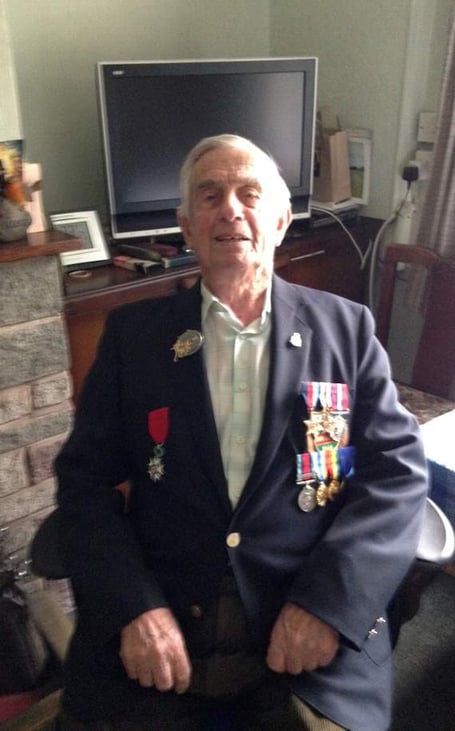
France has awarded its highest honour to those men who fought and risked their lives to secure France’s liberation during the Second World War. The Ross Gazette recently featured a Ross-on-Wye man, Jim Jenkins who was awarded the Légion d’honneur. However Mr Jenkins is not the only local veteran to receive this medal, and in the St Weonards branch of the Royal British Legion there are three D-Day veterans who are proud to receive it.
One of the other members of St Weonards branch of the RBL is Peter Harness, who waited 70 years for recognition of his wartime service. He was one of the seamen who kept supply lines to the Eastern front open. He was presented with the Arctic Star medal by the Prime Minister in 2013 and now has the Chevalier in the Ordre National de la Légion d’honneur to add to his growing collection.
Former Vice chairman of the St Weonards branch, Peter Davies is another veteran from the local area to receive the medal. He remembers his war time experiences with great clarity. He told the Ross Gazette that at times it was ‘horrendous’ but he got through it because he believes he is a ‘very lucky man’ and also that you can find humour in any situation.
Mr Davies joined the Air Force at the age of 17 and carried out his training to become a wireless operator in Blackpool. Then in 1942 there was a shortage of wireless operators in the desert so he transferred to the army but he never got to the desert.
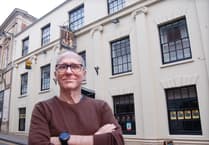
He became a main gunner in a tank crew. He said:?“I wanted to have something I could fight back with.”
Mr Davies recalls the build up to D Day on Tuesday, June 6th, 1944. The training increased, and included practice landings in East Anglia and Scotland. He said this was because the tides off the north coast of Scotland were similar to the north coast of France.
Secrecy also increased and one man who left camp without permission, because he wanted to see his wife, was sentenced to six months in prison.
Mr Davies said:?“We knew the invasion was coming and we thought is was going to happen on June 5th. We moved our tank onto our landing gear on June 3rd but then a terrible storm blew up. One inch thick cables holding barrage balloons snapped in the severe weather so the invasion was delayed.”
He told the Ross Gazette that he can remember very clearly the sight of so many ships and boats of all different sizes, some 4000 of them. He said:?“I did not think there were that many ships in the world and they could never do anything like it nowadays, as there are not so many boats and ships around.”
He said one of the amazing facts he recalls was that all the battleships were trying to stay in position without being seen by the enemy. They were moved to the north for 12 hours and then south for 12 hours so the following day they were back where they started. He said it was amazing to think a whole battle fleet could be moved in secret.
He said everyone knew this was the real thing and secrecy was so important.
Mr Davies recalls several other terrifying incidents when he said he knew he was lucky. He was reported missing, presumed killed, along with the other members of the crew when the tank they were in was knocked out on a battlefield. He said:?“No-one saw us for several hours so they thought we were dead.” Actually he said they were behind enemy lines hiding in a ditch watching German soldiers eat their breakfast. While they were walking back to a French village a Spitfire came over and shot at them, he said they must have thought they were Germans because of their tank helmets.
He also recalls driving a tank in the snow-covered hills of the Ardennes. He said being inside an out of control 30 tons of metal was quite an experience.
Mr Davies has been blown up several times and considers the fact that he was able to come home, get married and share a happy life in Herefordshire with his family, and still be here to talk about his experiences must mean he is a very lucky man.
Comments
This article has no comments yet. Be the first to leave a comment.