
Pope’s Hill, overlooking the Severn valley and Flaxley is believed to be named after Mary Pope, the lifetime partner of Katharina Boevey who owned the Flaxley estate in the early 18th century.
Nigel Costley, Editor of the New Regard, the journal of the Forest of Dean Local History Society, tells her story in the 2026 edition.
Katharina Boevey was a wealthy heiress who turned down eligible suitors in favour of a life with Mary. During their lives together, they supported the local community and managed the estate and its ironworks. Their charity lives on to this day through the Catharina Boevey Fund for Apprenticing.
Mary Pope was born in 1665 into a country convulsed by civil war. She was the daughter of John Pope a Bristol Merchant and Margaret (nee Knight). They lived in the centre of the bustling city and the small tight-knit merchant community organised by Bristol’s Merchant Venturers.
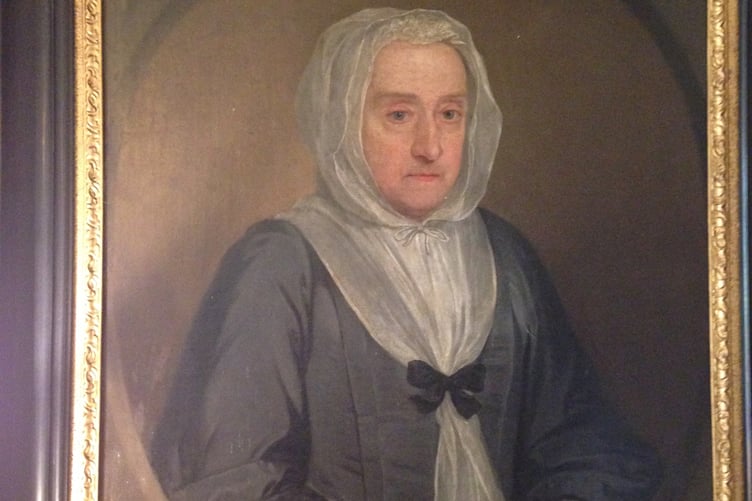
Mary’s father, John Pope, gained his status as freeman or ‘burgess’ on 4 November 1663, paying 4s 06d. Mary’s grandfather, also called John Pope, was the son of Michael Pope, a soapmaker, who had become a ‘burgess’ in 1637 and was a sheriff of Bristol 1653 to 1654. Mary’s mother, Margaret Knight came from a notable family in Bristol especially her father, Sir John Knight (1613-83) who was elected MP for Bristol in 1660 and again in 1679.
He represented the interests of the Bristol Merchant Venturers campaigning to break the monopoly granted to the London-based East India Company. Knight was fiercely opposed to Quakers, Non-conformists and Catholics.
After the restoration of King Charles II, Knight was returned as MP for Bristol in 1669 and became the most prominent provincial merchant in Parliament. He was appointed to an astonishing 624 committees, taking the chair in 16, acting as teller in 20 divisions. He made about 60 recorded speeches.
Knight ended his days with only moderate wealth, his Will saying that his daughters, “be maintained in meat, drink, lodging and apparel until they marry.” Margaret was already married by then and we will never know how much influence his strong political and religious views had on her or her daughter Mary, who would have been 18 at the time of his death.


After Mary’s father, John Pope, died her mother, Margaret, married Thomas Barrow of Field Court, Hardwicke in Gloucestershire in 1681. The 16-year-old Mary joined the well-to-do families of the Barrows and Boeveys that led Mary to visit Flaxley Abbey as a distant cousin to Katharina Boevey.
The Boeveys were Dutch Huguenot (Protestant) refugees who fled from Courtrai in Flanders.
Andreas Boevey (1566-1625) was aged seven when his parents came to England. His first wife Esther Fern had nine children, his second wife Joanna der Wilde had two more including James, born in London on 7th May 1622.
James Boevey grew up to become a cashier for the banker Dierik Hoste and to work for the Spanish Ambassador in London. Whilst King Charles II was in exile on the continent, James Boevey acted as a key contact for the King.
James Boevey and his half-brother William acquired Flaxley Abbey from the descendants of William Kingston in 1647.
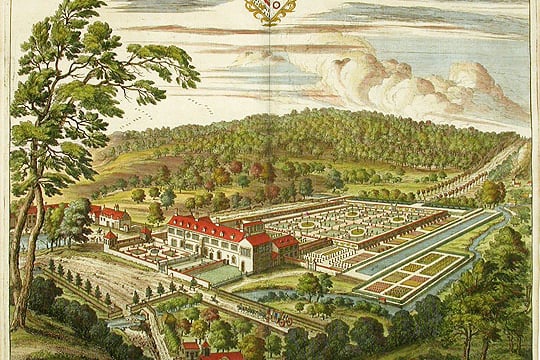
The Abbey is said to have been built on the spot where Earl Milo of Hereford was killed in 1141. In the chase for deer, Milo was separated from his hunting party and while alone he was struck down with an arrow piercing his heart.
The Abbey became a key destination for royalty and nobles. It was a stopping point between the great Cathedral and Llanthony Secunda at Gloucester and the Abbey at Tintern.
The monks bathed and drank the waters at the nearby St Anthony’s Well. They prayed for the departed and acted as hosts for the travelling groups of dignitaries. By the time the Boeveys bought the Abbey, it had stopped being a place of prayer.
James Boevey spent little time in Flaxley but his sister, widowed by the plague in 1621, came to live at the Abbey where she became known locally as the ‘Lady of Flaxley’. She died in 1670.
In 1667, a year after the great fire of London, William Boevey was born to James and his wife Isabella. Aged about 28, William Boevey married Katharina Riches, the 15-year-old daughter of John Riches, in St James Church, Piccadilly on 26 May 1685. Katharina Riches was also a Dutch emigree from Amsterdam. Asylum seekers are a key part of our history!
After a short honeymoon William and Katharina took the long journey from London along the dangerous old Roman road past the Highwayman Inn to the home of Thomas Crawley in Gloucester. The next day horsemen went ahead to alert the Abbey staff of the arrival of their new residents. A large gathering raised an arch of flowers for the newly-weds.
Katharina fell in love with Flaxley. The gardens were laid out in the style that Dutch refugees brought to England.
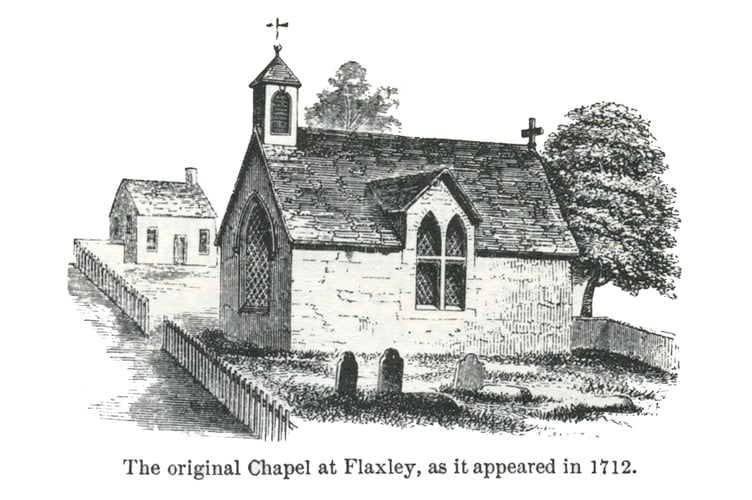
She worshipped in the tiny wooden chapel and began her life-long charitable support amongst the 30 or so families that lived in Flaxley. William laid out the gardens and became involved in the management of the Forest of Dean.
The marriage between Katharina and William, however, was not a happy one. Katharina had little if any affection for William. She didn’t complain despite his excesses and ill-humour.
We do not know William’s side of the relationship except for an exchange of poems. It would seem that whatever love they felt for each other it quickly faded. It is hard not to consider that her sexuality may have been a factor in the unhappy marriage.
Katharina’s life was helped by the company of visitors. Her sister Anna came in 1689 but died at Flaxley aged just 18.
The most important arrival was that of Mary Pope, her new cousin from Bristol who came for a short holiday in 1686. Katharina, then aged 17, persuaded Mary, aged 21, to stay a little longer. Mary stayed for the next 40 years.
In August 1692, William, aged 35, died of dropsy (known today as odema) after much suffering. His Will left the estate to Katharina and on her death, it was to pass to Thomas Crawley on condition he adopted the name Boevey.
He also left a bequest to Mary Pope and money for land to provide an income to apprentice poor children in Flaxley.
With the support of Mary Pope, the young and beautiful widow Katharina was in complete charge of Flaxley Abbey and iron workings.
They enjoyed the summer months in Flaxley, then retreated to a town house in Duke Street, Westminster. Whilst in London Katharina kept in contact with her Flaxley bailiff, Mr Bate. Other servants included John James, Matthew Stevens and Rachel Vergo.
Vergo had worked at the Abbey since she was 20. Under the supervision of Mary Pope, Vergo took charge of the maids and other servants required to maintain the large estate. She turned down offers of marriage from the butler as it would have meant leaving the Abbey. Vergo stayed until Katharina’s death and only then married him.
Katharina, now using ‘Bovey’ as her surname, took a close interest in her iron interests. Flaxley valley was a hive of activity with mills and furnaces. Some 8,500 tons of timber were needed to make into charcoal to produce the iron.
She loaned some of her charcoal to Lady Francis Wintour of Lydney in the winter of 1699-1700 and negotiated with the Crown authorities for a further 852 cords to produce more.
Katharina suffered a major blow in 1723 when a large supply of iron was stolen while waiting to be loaded for transport from Broadoak, near Newnham. Furnacemen were reported as taking bribes from competitors and her manager is said to have defrauded her. Letters, including gold payments, were stolen by highwaymen.
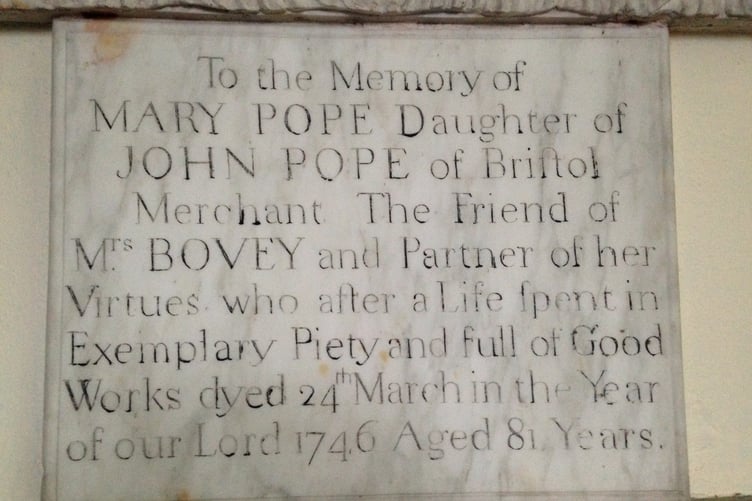
Mary Pope was a constant companion to her during these tribulations. The two women were devoted to each other – most likely in a lesbian relationship although we will never know the true extent of this. Mary Pope’s headstone describes her as:
“the friend of Mrs Bovey and partner of her virtues”.
A young, attractive and very wealthy widow, Katharina had many suitors and admirers. But none got close, with Mary Pope being blamed for deterring such interest.
Richard Steele, one such suitor, was one of the founders of the Spectator magazine in 1711. A feature in the journal was the life of Sir Roger de Coverley, a fictional character based on the true life of Steele.
Sir Roger describes Flaxley Abbey and his attempt to woo the widow.
“This agreeable seat is surrounded with so many pleasing walks, which are struck out of a wood, in the midst of which the house stands, that one can hardly ever be weary of rambling from one labyrinth of delight to another.”
Of Katharina he says:
“I have been fool enough to carve her name on the bark of several of these trees; so unhappy is the condition of men in love. She has certainly the finest hand of any woman in the world.”
“She is the benefactress of a village adjoining to her estate and takes a special interest in all its love affairs.”
Roger struggles with his love for the widow:
“This perverse woman is one of those unaccountable creatures, that secretly rejoice in the admiration of men but indulge themselves in no further consequences. Hence it is that she has ever had a train of admirers.”
“I call her indeed perverse, but, alas! Why do I call her so? Because her superior merit is such that I cannot approach her without awe, that my heart is checked by too much esteem: I am angry that her charms are not more accessible.
Mary Pope is blamed for turning the widow against Sir Roger, indeed all men and marriage. The accounts claim that Mary Pope had great power and influence over her mistress’s mind and wielded her power mercilessly.
“She is always accompanied by a confidant, who is witness to her daily protestations against our sex, and consequently a bar to her first steps towards love, upon the strength of her own maxims and declarations”.
“Her Confidant … this malicious aid of hers … has kept me ever at a distance from the most beautiful object my eyes ever beheld”.
“Whether the taste the good lady had of matrimony discouraged her or not, I cannot say; but though her merits and her riches have attracted many suitors, she has never been tempted to venture again into the happy state”
“You do not see one heiress in a hundred whose fate does not turn upon this circumstance of choosing a confidant”.
History does not record Mary’s or Katharina’s responses to such descriptions.
Other visitors came to Flaxley. Mrs Cowling and Mrs Grace Butler came to visit Mary Pope at the time of the epidemic fever raging in Gloucestershire in 1719. While at Flaxley, Mrs Cowling succumbed to the disease and died.
She was buried in a new vault in Flaxley churchyard and there was a pact between the women that Katharina, Mary and Grace should be laid alongside her when their time came. The promise was kept: Mary Pope’s body was brought from Twickenham in Surrey and Grace Butler from Worminghurst in Sussex twenty years later.
Another visitor was Alexander Pope en route between Bath and Herefordshire; the poet was no relation to Mary.
Katharina is remembered for being a generous benefactor to various charities. The most lasting of her causes is the Three Choirs Festival which she helped establish, bringing together the cathedral choirs of Hereford, Gloucester and Worcester.
She helped support villagers in need, sending Rachel Vergo to Ross to buy materials to make them garments. She encouraged the education of local children, mainly in the instructions to be good Christians.
With her health deteriorating, Katharina invited thirty local children to dine at the Abbey with beef and pudding. She dressed in white and silver, adorned with her finest jewels. At the end of the meal she gave each child sixpence. Katharina expected death and wanted to put on a display for the children. She told Vergo:
“You will be surprised that I put such fine clothes on today, but I think that these poor children will remember me the longer for it.”
The children danced and played in the great hall for two hours accompanied by a harp and fiddle.
Katharina died a month later, seized with violent pain from a bowel complaint. Katharina expressed satisfaction at facing her death in Flaxley, where she always wanted to die.
She died on the Saturday morning, 21 January 1726 aged 56 and was laid to rest alongside Mrs Cowling on 23 January in a private ceremony.
The Flaxley estate passed to Thomas Crawley (d.1741), a London merchant in ‘tail male’, meeting the condition that he add Boevey to his name. His grandson became a Baronet on the death of Sir Charles Barrow in January 1789. Barrow was an MP for Gloucester.
Katharina’s Will provided for local apprentices, a fund that still supports young people under the age of 25 who live in or around Flaxley. She bequeathed £12,000 for Mary Pope to replace the small Flaxley chapel with a bigger church that Katharina had designed. Some controversy followed over how quickly Mary arranged it.
The Parishioners instituted a Suit in Chancery to secure the work. Mary responded to the criticisms by completing the project in a timely fashion. To stress the point, Mary literally set the record in stone. The plaque in Flaxley states Katharina:
“designed the re-building of this Chapel, which pious design of hers was speedily executed by Mrs Mary Pope”.
For years after the church was apparently known as the ‘Mary Pope Church’ adding weight to the case that the Hill was named after her too.
Katharina left £400 for Mary Pope and Thomas Crawley-Boevey to spend on the poor in Flaxley. £1,200 was given to purchase property to generate income to be used to read prayers in Flaxley Chapel, the catechising (teaching of Christianity) of children and visiting the sick of the parish.
Mary, appointed executrix, was left the remainder of Katharina’s estate, believed to be a considerable sum for the then 62-year-old.
Mary was invited to take some of the books from Katharina’s considerable library at Flaxley. It seems that she took most of them, to the consternation of others who had an eye for some of the collection. There may well have been long-standing resentment towards Mary from family and friends.
It is not clear how much time Mary continued to spend at Flaxley after Katharina’s death but she remained a key part of the community.
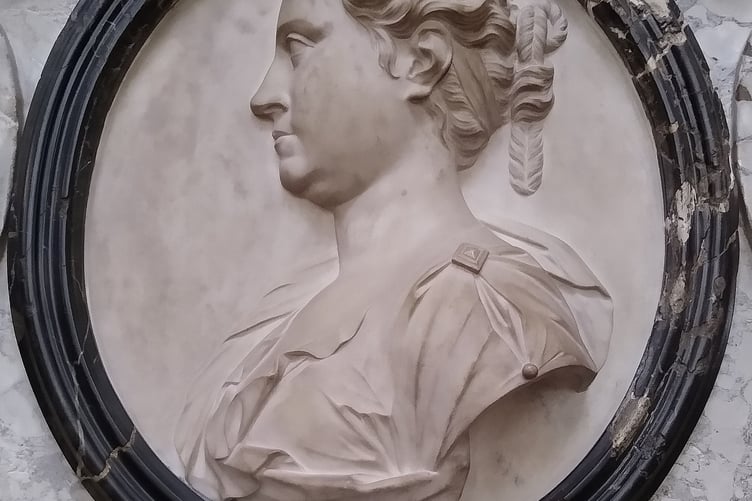
She retained properties in the area as her Will lists “lands and tenements in the parish of Newnham”. Mary enjoyed taking strolls in the area and no doubt taking in the spectacular views from the top of the nearby hill.
Mary spent more of her time in Twickenham in London where she died on 24 March 1746 aged 81 years. Her body was returned to Flaxley and laid to rest alongside Katharina.
Comments
We've recently changed our login process. If you have an account for commenting, you will need to re-register on the login window.
This article has no comments yet. Be the first to leave a comment.