
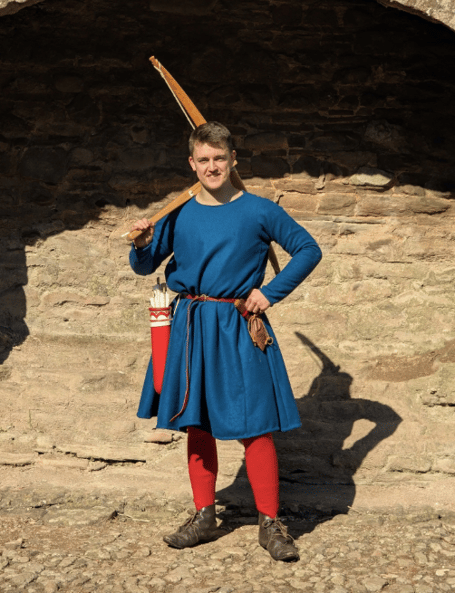
ROSS-on-Wye will have its own place alongside one of the world’s most famous pieces of medieval history after a local craftsman was commissioned to create two crossbows for the new Bayeux Tapestry Museum.
Professional medieval crossbow maker Matthew Hotston has produced two historically reconstructed 11th-century weapons which are set to go on display when the redeveloped museum opens in Normandy.
Mr Hotston, who runs Hotston Balistarius and is a former John Kyrle High School pupil, said he had been commissioned by the museum to make the crossbows and expects to ship them to France within the coming weeks.
He said the museum’s director had confirmed he was the only English craftsman involved in supplying historical reconstructions for the new attraction.
That would mean the two crossbows, made in Ross, will be the only English-made objects displayed in the museum apart from the Bayeux Tapestry itself.
Mr Hotston has been making crossbows for the past four years and is now turning the craft into a full-time venture.
Through Hotston Balistarius, he specialises in producing historically accurate early and high medieval crossbows for re-enactors, museums and collectors.
His work focuses particularly on periods where he believes crossbows have been underrepresented in historical re-enactment, despite their prevalence during the Middle Ages.
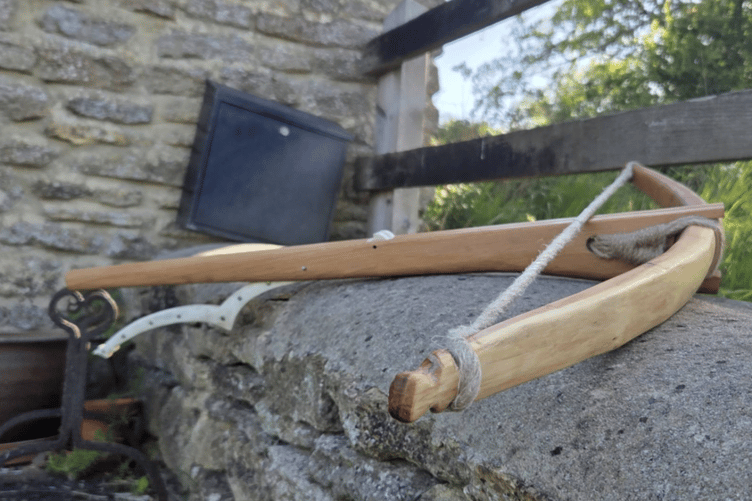
His handmade pieces aim to reproduce the appearance, proportions and feel of medieval weapons while remaining practical for modern re-enactment.



Alongside crossbows, he produces bolts, arrows and arrowheads and takes on bespoke higher-end commissions covering the 11th to 13th centuries, with historically inspired details including genuine antler roll nuts and triggers.
His latest commission places that specialist craftsmanship alongside an artefact recognised around the world.
The Bayeux Tapestry tells the story of the events surrounding the Norman Conquest of England, culminating in the Battle of Hastings in 1066 when William, Duke of Normandy, defeated King Harold II.
Despite its name, the almost 70-metre-long work is an embroidery and is widely believed to have been created in England during the 11th century.
Its scenes of ships, soldiers, horses and weaponry have provided historians with an extraordinary visual record of the period.
Crossbows have their own connection to the story.
The Bayeux Museum cites contemporary chronicler William of Poitiers, whose account of the Battle of Hastings referred to troops armed with arrows and crossbows, although their precise use during the battle and representation within the tapestry have been debated by historians.
The existing museum closed in 2025 for a major redevelopment intended to transform how the tapestry and the world surrounding it are presented.
The new museum is due to open in October 2027, during the 1,000th anniversary year of William the Conqueror’s birth.
Its displays will explore the tapestry’s creation, history and the society surrounding the events it depicts.
The project will also give visitors a closer look at warfare during the Norman Conquest.
For Mr Hotston, it means a specialist craft developed in Ross will become part of the modern interpretation of a story which changed English history almost 1,000 years ago.
To keep reading all your favourite stories online, subscribe to the Ross Gazette and use promo code LUKEDAVIS to get £10 off your annual subscription.
Comments
We've recently changed our login process. If you have an account for commenting, you will need to re-register on the login window.
This article has no comments yet. Be the first to leave a comment.