

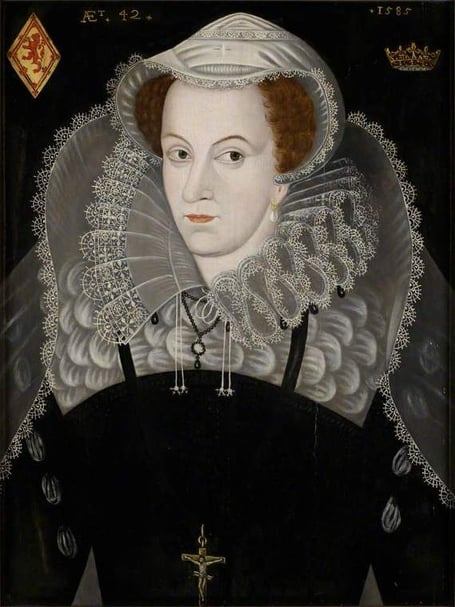
History was brought to life for members of the Ross-on-Wye Kyrle Probus Club, by Dr Gillian White at their December meeting, and the subject of her talk was the infamous British monarch, Mary Queen of Scots.
What was the fascination Mary held for people? This was the question posed by Dr White. One reason, she said, was that her life provides a ripping yarn. Something else that maintained the fascination with her, are the gaps in the historical evidence around her which people want to fill.
Mary very much polarised opinion. Was she a wicked woman or an innocent victim?
She was born on December 8th, 1542 at Linlithgow Palace just outside Edinburgh. She was executed on February 8th, 1587, at the age of 44, having been found guilty of treason and in between those dates, her life was marbled with great expectation, tragic personal loss, murder, suspicion and plotting, before the final horrific denoument.




Just six days after her birth, her father James V died and Mary went to her coronation at less than a year old. Her expectation arose when Mary Tudor of England died and it was then shattered when she was replaced by Elizabeth I. Mary felt she could have been Queen of England, as well as Scotland, and also of France through marriage.
Within two years, her father-in-law, the nearest she ever had to a father, her mother and her young husband, the Dauphin Francois, all died. Her destiny in ruins, she returned from France to Scotland, where murder and mystery then dogged her life. She married a nobleman, Lord Darnley, who became implicated in the murder of a favourite assistant of Mary’s, an Italian, David Rizzio.
Mary was pregnant at this time, and after the birth of her son, James VI, more intrigue followed. Lord Darnley was murdered, found strangled in the orchard of his home. James Hepburn, Lord Bothwell, was brought to trial for the crime, but on the day no witnesses turned up, no evidence was given and he walked free.
Mary’s role in Darnley’s death is a crucial point on which her reputation stands or falls, suggested Dr White. Historians just can’t decide whether she was involved in the plot to murder her husband. In an extraordinary act, a month after the non-trial, Mary married Bothwell. This was too much for many of her lords, who rose against her, took her prisoner and forced her at sword point, to abdicate. She was 24 years old.
Having managed to escape from prison, she went south to England to throw herself on the mercy of Queen Elizabeth. But Elizabeth, suspicious of her motives, placed her under house arrest, and Mary was effectively a prisoner in England for 19 years.
When incontrovertible evidence of her involvement in a plot against Elizabeth was discovered, she was charged with treason, found guilty and executed. Even this final act was tinged with the macabre, as the executioner bodged the job, taking three blows to sever the head.
After 16 years passed, Queen Elizabeth I died and James VI of Scotland travelled south to become King James I. This was Mary’s son, whom she hadn’t seen since he was nine months old, and who had been raised to think the worst of her.
Dr White said we might think Mary’s was a tragic and unfulfilled life, but suggested she could have the last laugh. She said: “Mary is not forgotten after more than 400 years, and every monarch of this country has been descended from her – that is an achievement.”
Comments
This article has no comments yet. Be the first to leave a comment.