

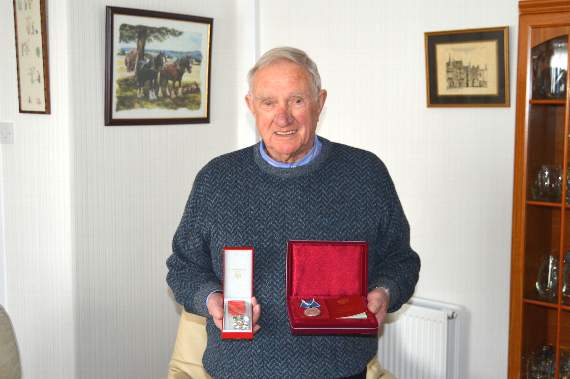
Almost three years to the day that Pete Harness was presented with his Arctic Star medal for his services during World War II, in Downing Street, he returned to London for another presentation. This one was the Ushakov Medal, which was presented by the Russian attaché on behalf of the Embassy of the Russian Federation.
This is the third medal Pete has been awarded with recently. He is one of the three members of the Wormelow branch of the Royal British Legion who have received the French medal, which is awarded to those appointed to the rank of Chevalier in the Ordre National de la Legion d’honneur, along with Peter Davies, from Orcop, and Jim Jenkins, from Glewstone.
He has been sent the French medal, which was given to all those who helped in the liberation of France in WW II, but so far no official presentation has been arranged.
When Mr Harness asked if the Russian medal could be posted, rather then having to attend the Embassy, he was told that they ‘do not send Russian silver through the post.’


The medal is in recognition of the time Mr Harness spent keeping the supply lines to the Eastern front open. Pete originally wanted to join the Royal Navy in 1943, but his father stopped him as he was too young, instead in 1944 Pete signed up with the Merchant Navy. He was one of the sailors who spent months dealing not just with the enemies trying to torpedo and sink them, but the cold and terrible conditions. “It was hell,” Pete said, he does not like to talk about his time there in detail. He told the Ross Gazette that he is pleased that, even though it has taken over 70 years, the contribution they made to the war effort has been acknowledged.
The letter accompanying the medal quotes Winston Churchill who called it ‘the worst journey in the world’ and said it required an extraordinary level of commitment which went way beyond ‘what might be considered the call of duty’.
The medal was originally created in 1944 and featured the Russian admiral Fyador Ushakov, who never lost a battle and is patron of the Russian Navy.
Mr Harness survived two journeys but always had the feeling that the Russians hated them, so he said to receive the medal was very pleasing.
He recalls a friend who he had been at sea with listening to Songs of Praise on the radio and crying because he wanted to go home. Mr Harness said:?“It was the darkness, the weather, but he still signed up for the second trip.”
Mr Harness has taken part in many Remembrance Day events and will wear these new medals with pride. He intends to wear them for the first time at the Violette Szabo Memorial Picnic on June 26th at the Wormelow Museum.
Comments
This article has no comments yet. Be the first to leave a comment.